Chapter 1: Introduction: Saṅgīta and Nāṭya
This volume is about the performing arts of the Indian subcontinent: music, dance and theatre as they were theorised in Sanskrit, Tamil, Persian and the regional languages, and as they have been practised in temples, courts, shrines, villages, salons, concert halls and film studios over more than two thousand years. It covers the classical traditions that have their own treatises and specialised teachers — Hindustani and Karnatak music, the dance forms now called “classical”, Sanskrit drama and Kūṭiyāṭṭam (the Kerala temple theatre that is the only living tradition of Sanskrit performance, though a regional art of the second millennium rather than a survival of Kālidāsa’s stage) — but also the devotional music of the Sufi shrine and the Sikh gurdwārā, the regional dance-dramas, and the folk and tribal performances that have always existed beside them and fed into them.
Two older words cover most of this ground. Saṅgīta is the medieval Sanskrit name for the combined art of song, instrumental music and dance. Nāṭya is the ancient name for drama, understood as a total art in which speech, song, instrumental music, gesture, dance, costume and make-up work together to produce an aesthetic experience in the spectator. What follows explains these terms, the kinds of evidence from which the history of the arts is reconstructed and the outline of that history, and then three themes that run through the whole volume: the people who made the arts and the communities to which they belonged; the ways in which knowledge of performance has been transmitted; and the relationship between performance and the sacred.
1.1 The Terms: Saṅgīta and Nāṭya
1.1.1 Saṅgīta
In modern Indian languages saṅgīt or saṅgītam simply means “music”. In the medieval treatises the word had a wider sense. Śārṅgadeva’s Saṅgītaratnākara (“Ocean of Saṅgīta”), composed in the first half of the thirteenth century at the Yādava court of Devagiri, opens its account of the subject with a definition that later writers repeated many times:
Saṅgītaratnākara 1.1.21
gītaṃ vādyaṃ tathā nṛttaṃ trayaṃ saṅgītam ucyate
“Song, instrumental music and dance — these three together are called saṅgīta.”
The Saṅgītaratnākara accordingly devotes its first five books to sound, scales, rāgas, ornaments, compositions and rhythm, its sixth to instruments and its seventh to dance (Shringy and Sharma 1978). Song is placed first and treated as primary: instruments follow song, and dance follows instrumental music. Śārṅgadeva also divides saṅgīta into two kinds, mārga (“the path”), the ancient, rule-bound art said to have been discovered by Brahmā and practised by Bharata and others before Śiva, and deśī (“regional”), the music and dance that please people in different regions and change with time. In practice the mārga music described in the old texts had largely gone out of use by Śārṅgadeva’s time, and nearly everything the later treatises describe is deśī (Rowell 1992; Widdess 1995). The distinction between a learned, codified art and a popular or regional one, and the constant movement of material from the second into the first, is one of the oldest ideas in Indian thinking about performance (Section 1.7).
1.1.2 Nāṭya
The older and larger frame is nāṭya. The Nāṭyaśāstra (“Treatise on Nāṭya”), ascribed to the sage Bharata and compiled between about 200 BCE and 200 CE, is the earliest surviving text on the performing arts in India. It treats drama as the master art, and it discusses music and dance chiefly as components of a theatrical performance: the playhouse and its consecration, the preliminary rituals, the movements of the body, the hands and the eyes, the representation of emotion, the types of play and plot, costume and make-up, the scales and modes of music, the instruments, the songs (dhruvā) sung during the action, and the distribution of roles among actors. Its origin myth, in which the god Brahmā creates drama as a “fifth Veda” open to all classes of society, makes the claim that nāṭya contains all knowledge, all arts and all crafts (Ghosh 1950; Vatsyayan 1996). The text, its structure, its history and its theory of the body are the subject of Chapter 2; its theory of emotion and of the spectator’s experience, rasa, is treated from the performer’s point of view in Chapter 3.
1.1.3 Nṛtta, nṛtya and nāṭya
Later writers distinguished three ways in which the body can perform. Nṛtta is “pure” dance, movement that follows rhythm and creates beauty of line and pattern but does not represent anything; nṛtya is expressive dance, in which gesture, facial expression and movement interpret the words and emotions of a song; and nāṭya is drama, the representation of a story by actors. The Nāṭyaśāstra itself knows nṛtta but not yet this threefold scheme, which is found in Dhanañjaya’s Daśarūpaka (late tenth century) and in the Abhinayadarpaṇa attributed to Nandikeśvara, and which has become the basic vocabulary of modern dance teaching. Every classical dance form combines the three in different proportions: a Bharatanāṭyam recital alternates passages of nṛtta with passages of nṛtya, while Kathakaḷi and Kūṭiyāṭṭam are primarily nāṭya. Chapter 13 discusses the distinction in detail (Bose 1991).
1.1.4 Lakṣaṇa and lakṣya
A final pair of terms describes the relation between the texts and the arts. Lakṣaṇa is the definition or rule given in a treatise; lakṣya is the actual practice that the rule describes. The authors of the treatises were well aware that practice came first and that their rules were descriptions of what good performers did, not the other way round; some of them say explicitly that where practice and text disagree, the treatise must follow practice. The history of Indian music and dance is therefore not the history of the application of a fixed theory but of a long conversation between theorists and practitioners, in which the texts constantly lagged behind, systematised, and sometimes reshaped the living arts (Rowell 1992; Bose 1991). A reader of this volume should keep in mind that a description in a Sanskrit text — of a rāga, a hand gesture or a dance step — does not by itself show how it was performed in the text’s own time, let alone that it is performed the same way today.
1.2 Sources and Evidence
1.2.1 Treatises
The history of the performing arts is reconstructed from several kinds of evidence, each with its own limitations. The most explicit are the treatises (śāstra) on music, dance and drama, a large literature in Sanskrit and, from the fourteenth century, also in Persian and in the regional languages. Table 1.1 lists the most important works discussed in this volume. Their dates are often uncertain, and many survive only in late manuscripts or in incomplete form.
| Work | Author | Date | Subject |
|---|---|---|---|
| Nāṭyaśāstra | ascribed to Bharata | c. 200 BCE–200 CE | Drama, dance, music; the foundational text |
| Dattilam | Dattila | early centuries CE | Gāndharva music: śruti, grāma, jāti, tāla |
| Bṛhaddeśī | Mataṅga | 2nd half of 1st millennium CE | First known definition of rāga |
| Daśarūpaka | Dhanañjaya | late 10th c. | The ten types of drama |
| Abhinavabhāratī | Abhinavagupta | c. 1000 | Commentary on the Nāṭyaśāstra |
| Saṅgītaratnākara | Śārṅgadeva | 1st half of 13th c. | Music and dance; the standard medieval synthesis |
| Abhinayadarpaṇa | ascribed to Nandikeśvara | uncertain | Gesture and expressive dance |
| Svaramelakalānidhi | Rāmāmātya | 1550 | Classification of rāgas by scale (mela) |
| Caturdaṇḍīprakāśikā | Veṅkaṭamakhin | mid-17th c. | The 72-mela scheme |
| Rāg Darpan (Persian) | Faqīrullāh | 1666 | Music at the Mughal court |
| Hindustānī Saṅgīt Paddhati | V. N. Bhatkhande | 1910–1932 | The ten-thāṭ system |
The texts were written by learned men, usually Brahmins or courtiers, for patrons and connoisseurs. They tell us how the arts were classified and what educated people thought about them, but they rarely describe the social life of performers, and they are often conservative, repeating the categories of earlier texts long after practice had changed. Chapter 4 traces how the rāga concept emerged from Mataṅga to Śārṅgadeva and beyond, and Chapter 6 follows the literature of music theory as a whole from the Dattilam to Bhatkhande; Chapter 12 discusses the later dance treatises, including the regional texts on which the modern dance forms have drawn.
From the late fourteenth century music in north India was also written about in Persian, in a literature long ignored by historians who looked for the history of Indian music only in Sanskrit; its study has transformed the understanding of the period between Śārṅgadeva and the nineteenth century (Section 7.2) (Schofield 2010; Bor et al. 2010).
1.2.2 Literature, inscriptions and images
Poetry, drama and narrative literature describe performances and performers vividly, though not always realistically. The Sanskrit plays of Kālidāsa (c. 4th–5th century) include scenes of dance and music lessons; the Tamil epic Cilappatikāram, usually dated to the middle centuries of the first millennium, describes the training and debut of the courtesan-dancer Mātavi in such detail that it has become a key source for early Tamil music and dance (Parthasarathy 1993). Inscriptions record gifts to temples for musicians and dancers, the names and duties of temple women, and the patronage of kings. Sculpture and painting provide images of instruments, dancers and ensembles over two thousand years, from the reliefs of Bharhut and Sanchi to the temple sculptures of the Cōḻa period and the rāgamālā paintings of the Rajput and Deccani courts (Chapter 4) (Vatsyayan 1968; Ebeling 1973). Images and literary descriptions must be read with care: sculptors and painters followed their own conventions, and a carved figure in a dance-like pose does not tell us how a dance moved in time.
1.2.3 Living practice and its limits
The most important evidence for the arts of the last two or three centuries is living practice itself: the repertoires, techniques and oral knowledge of hereditary and institutional lineages, documented by ethnographers, historians and practitioners. Here the risk runs the other way. Performers often describe their art as ancient and unchanged, but most living traditions have been reshaped many times, and some of the most important changes took place in the twentieth century. Much of the historical writing reviewed in this volume — on Bharatanāṭyam, Kathak, Odissi, Hindustani music and the Karnatak concert — shows how claims of antiquity were made, for good and bad reasons, during the nationalist reconstruction of the arts (Bakhle 2005; Weidman 2006; Soneji 2012; Walker 2014). The reader will meet these debates repeatedly. Recognising that a form took its present shape in the 1930s does not make it less valuable or less Indian; it makes its history more interesting.
1.3 A Historical Outline
1.3.1 Before the texts
The earliest evidence for performance in the subcontinent is visual. Rock paintings at Bhimbetka and other sites in central India, of widely varying and often uncertain date, show groups of figures in what appear to be dances. From the Indus (Harappan) civilisation of the third millennium BCE come a small bronze female figure from Mohenjo-daro, popularly called the “dancing girl”, and a few other figurines and seal images; whether the bronze represents a dancer is not known, and no Harappan text can be read. Claims that the classical dance forms descend directly from these objects are speculation.
1.3.2 The Vedic period
The Vedic hymns (the Ṛgveda is usually dated c. 1500–1200 BCE, the later Vedic texts c. 1200–500 BCE) were recited with pitch accents that are still preserved in traditional recitation, and the melodies (sāman) of the Sāmaveda, sung by a special class of priests at the soma sacrifice, are the earliest Indian music of which something is known in detail (Rowell 1992; Howard 1977). The Vedic texts also mention harps or lutes (vīṇā, vāṇa), drums, flutes and cymbals, and describe rites at which women danced and played. The Nāṭyaśāstra and the Dattilam connect the sacred music of the theatre’s preliminaries (gāndharva) with the Sāmaveda, but the link between Vedic chant and the later art music is indirect and its details are not documented; the accents, the chant and the question of continuity are discussed in Chapter 4 (Rowell 1992; Nijenhuis 1970).
1.3.3 The early historic period
Buddhist and Jaina texts of the last centuries BCE mention professional musicians, dancers, actors and story-tellers, and the stone reliefs of the Buddhist monuments of Bharhut and Sanchi (2nd–1st century BCE) show celestial women dancing to the music of harps, flutes and drums. The Hāthīgumphā inscription of King Khāravela of Kaliṅga (1st century BCE) records that he entertained his capital with dance, song and instrumental music. Gold coins of the Gupta king Samudragupta (r. c. 335–375) show the king seated, playing a harp-like vīṇā. It is to this world of royal courts, cities and wealthy patrons that the Nāṭyaśāstra belongs, and to its later centuries that the great Sanskrit dramatists belong: Bhāsa (before Kālidāsa; the thirteen “Trivandrum plays” attributed to him are of debated authorship), Kālidāsa (c. 4th–5th century), Śūdraka (Mṛcchakaṭika, c. 3rd–5th century) and later Viśākhadatta, Harṣa (r. 606–647) and Bhavabhūti (early 8th century). Their plays and the theatre that performed them are the subject of Chapter 19 (Keith 1924; Richmond et al. 1990).
The Buddhist and Jaina canons add evidence of another kind, the more valuable because it comes from outside the courtly theory. The precepts taken by Buddhist novices, and by lay people on fast days, include abstention from watching dancing, singing, instrumental music and shows, a rule that presupposes how common such entertainments were. The Jātaka stories of the Buddha’s former lives are full of court musicians, dancers and festival performances. In the Guttila Jātaka the Bodhisatta is Guttila, the master vīṇā player of Banaras, whose ungrateful pupil Musila challenges him to a public contest before the king; at the contest Guttila breaks the strings of his vīṇā one by one and goes on playing on the bare instrument, while Musila’s vīṇā, its strings broken in the same way, falls silent (Cowell 1895–1907). The Jātakas cannot be dated closely — the prose in which most of them are preserved belongs to a commentary of the middle of the first millennium CE, although many of the stories are older — but they show the vīṇā as the instrument of the professional master, music as a competitive art judged by royal patrons, and the teacher–pupil bond as both a bond of obligation and a source of rivalry. Jaina canonical texts include dance, song and instrumental music among the arts (kalā) a cultivated person was expected to learn, and describe gods honouring the Jinas with spectacles of music and dance. Such sources tell us what the arts meant to monks, merchants and lay devotees, an audience that the Sanskrit treatises rarely consider.
In the Tamil south, the anthologies of Caṅkam poetry (early centuries CE) describe bards (pāṇar) who played the yāḻ, a harp, and women dancers (viṟali) who travelled from patron to patron, and distinguish melodic modes called paṇ associated with the landscapes of Tamil poetry. The Cilappatikāram gives the first extended Tamil description of a dancer’s training, of a stage and of an accompanying ensemble, and its medieval commentary by Aṭiyārkkunallār is a major source for early Tamil music (Parthasarathy 1993). Tamil literature thus provides a second ancient theoretical and literary tradition beside the Sanskrit one; the two interacted but neither can be reduced to the other.
1.3.4 Temples, courts and devotion (c. 600–1500)
In the second half of the first millennium the great temples became major centres of performance. Temple inscriptions in Tamil Nadu, Karnataka, Andhra and Odisha record the endowment of musicians, drummers and dancing women; the Cōḻa temples of the tenth to thirteenth centuries carry sculptural sequences of the 108 karaṇas described in the Nāṭyaśāstra, most completely on the gateway towers of the Naṭarāja temple at Chidambaram, where the figures are accompanied by the relevant verses of the text (Vatsyayan 1968; Gaston 1982). In Kerala, Sanskrit drama was performed in temple theatres by hereditary actors in the form now called Kūṭiyāṭṭam, the only surviving tradition of Sanskrit theatre (Chapter 19).
Devotion (bhakti) shaped the music of this period profoundly. The Tamil Śaiva and Vaiṣṇava poet-saints, the Nāyaṉmārs and Āḻvārs (c. 6th–9th centuries), composed hymns to be sung in temples; the Śaiva hymns, collected as the Tēvāram, are still sung by temple singers (ōtuvār) in melodic modes descended from the old paṇs (Peterson 1989). In the twelfth century Jayadeva composed the Gītagovinda, a Sanskrit song-cycle on the love of Rādhā and Kṛṣṇa that became the most widely performed devotional text of medieval India, sung and danced in Odisha, Kerala, Manipur and elsewhere. Later bhakti poets — Annamācārya (1408–1503) and Purandaradāsa (1484–1564) in the south, the Vārkarī poets of Maharashtra, Kabīr, Sūrdās and Mīrābāī in the north, Caitanya and his followers in Bengal, Śaṅkaradeva in Assam — composed songs that are the basis of much later devotional and art music, and in several regions devotional movements created their own forms of theatre and dance, such as the Vaiṣṇava dance-dramas of Assam and Manipur (Chapter 18).
1.3.5 Persianate courts and Sufi shrines (c. 1200–1800)
From the thirteenth century the courts of the Delhi Sultanate and later the regional sultanates brought Persian poetry and music, and Persian and Central Asian musicians, into contact with Indian music. The Sufi orders, especially the Chishtīs, made music a central part of their devotional assemblies (samāʿ), and the poet Amīr Khusrau (1253–1325), a disciple of the Chishtī saint Niẓāmuddīn Awliyāʾ, became the emblem of this synthesis. Later tradition credited Khusrau with inventing qawwālī, several rāgas and genres, and even the sitār and the tablā; the last two claims are certainly false, and the others are traditions rather than documented facts (Chapter 7) (Sharma 2005; Qureshi 1986).
Under the Mughals (1526–1857), and at the courts of the Rajputs, the Deccan sultanates and later the successor states such as Awadh, north Indian music developed the genres, instruments and institutions of what is now called Hindustani music: dhrupad, which flourished at the court of Mān Siṃh Tomar of Gwalior (r. 1486–1516) and at the court of Akbar, where Tānsen (d. 1589) sang; khayāl, which became the leading vocal genre in the eighteenth century; the hereditary lineages of court musicians; and new instruments such as the sitār and later the sarod and tablā. Music was performed in courts and in the households of nobles, in the salons of courtesans, at Sufi shrines and in Hindu temples, often by the same musicians. Katherine Schofield has shown that the Mughal elite themselves regarded this music as a learned, “classical” art with its own canon, long before the nationalist reformers of the twentieth century used the word (Schofield 2010; Bor et al. 2010). In the south, the Vijayanagara empire (1336–1565) and the Nāyaka and Maratha courts of Thanjavur, Madurai and Mysore patronised the music and dance from which the Karnatak tradition and Bharatanāṭyam developed (Chapters 8 and 15). The gradual divergence of north and south Indian art music into two distinct systems, visible in the treatises from the sixteenth century, is discussed in Chapter 4.
In the Punjab, the Sikh Gurus made sung devotion the centre of worship. Guru Nānak (1469–1539) is remembered as travelling with the Muslim rabāb player Bhāī Mardānā, and the scripture compiled by Guru Arjan in 1604 and later given its final form as the Guru Granth Sahib arranges its hymns by rāga. Sikh kīrtan, sung by rabābī and rāgī musicians, is one of the major living traditions of rāga-based devotional music (Chapter 7) (Singh 2000; Mann 2001).
1.3.6 The colonial period and the twentieth century
The decline of the Mughal court and the fall of the princely courts of Awadh and elsewhere in the nineteenth century dispersed many musicians and dancers to smaller courts, to the cities and to the salons of courtesans, while the British administration, missionaries and Indian social reformers came to regard the professional female performers of north and south India as immoral. The “anti-nautch” campaigns that began in the 1890s, and later legislation against the dedication of girls to temples, removed much of the traditional patronage of women performers (Section 1.4).
At the same time, Indian nationalists set out to recover and reform the arts as symbols of national culture. Vishnu Narayan Bhatkhande (1860–1936) collected compositions from hereditary musicians, classified rāgas into ten thāṭs and published notated textbooks; Vishnu Digambar Paluskar (1872–1931) founded music schools from 1901 and set music in a devotional and respectable frame; the Madras Music Academy (1928) gave the Karnatak concert its institutional centre; the Kerala Kalamandalam (1930) and Kalakshetra in Madras (1936) became the model institutions for the training of dancers; and new dance forms were reconstructed from older practices and given Sanskritic names, beginning with the renaming of the court and temple dance of Tamil Nadu as Bharatanāṭyam in the 1930s (Bakhle 2005; Weidman 2006; Meduri 2005). After independence the Sangeet Natak Akademi (1952–53), All India Radio, the universities and later the Indian Council for Cultural Relations created the institutional structure of the “classical” performing arts that still exists. The film industry, recording, radio and television transformed popular music and dance, and the diaspora carried the arts across the world (Chapter 23).
1.4 Performers and Their Communities
Most histories of Indian music and dance until recently were histories of texts, theories and great masters. The people who actually performed — and the social worlds that sustained them — were often invisible, or described in ways that suited later ideologies. The research of the last forty years has changed this picture, and the chapters of this volume try to reflect it.
Before the twentieth century, music and dance in India were for the most part hereditary professions practised by particular communities. In the north these included the kalāwants, the court singers of dhrupad; the ḍhāḍhīs and mirāsīs, Muslim communities of genealogists, singers and accompanists, some of whom became the great khayāl and instrumental lineages; the kathaks, Hindu families of story-tellers and dancers; and the courtesans (ṭawāʾif, bāījī), women singers and dancers who were among the leading performers and patrons of ṭhumrī, ghazal and khayāl in the eighteenth and nineteenth centuries. The professional world was hierarchical: soloists ranked above accompanists, and the players of the sāraṅgī and the tablā, who accompanied courtesans, were held in lower esteem than the singers and instrumentalists who performed alone (Neuman 1980; Perron 2007).
In the south, the court and temple dancers later called devadāsīs and their male relatives — the dance masters (naṭṭuvaṉārs) and the nāgasvaram and tavil players of temple music — formed communities with their own matrilineal inheritance, their own professional knowledge and their own patrons. Women were dedicated to a temple deity, served in its rituals, danced at its festivals and at the courts, and often lived in long-term relationships with patrons outside marriage. Their status was ambiguous: they were auspicious and skilled, sometimes wealthy and literate, but also outside the norms of conjugal respectability, and their position depended on patronage relations that were at once artistic, economic and sexual (Kersenboom-Story 1987; Orr 2000; Soneji 2012). Similar communities of women performers existed in Odisha (the mahārīs of the Jagannātha temple), Andhra and Karnataka, and in different forms in north India.
The reform movements of the late nineteenth and twentieth centuries attacked these communities from several sides. Missionaries, colonial officials and Indian reformers — including members of the hereditary communities themselves, such as Muthulakshmi Reddy — campaigned against temple dedication and the “nautch”; the Madras Devadasis (Prevention of Dedication) Act of 1947 outlawed dedication in the Madras Presidency. Many families left the profession and sought respectability under new caste names such as Iśai Vēḷāḷar (“cultivators of music”). Meanwhile the dance itself was taken up, renamed and reshaped by middle-class and often Brahmin performers, most famously Rukmini Devi Arundale (1904–1986), who presented it as an ancient, spiritual temple art purified of the hereditary dancers’ associations; others, such as the hereditary dancer T. Balasaraswati (1918–1984), insisted that the art could not be separated from its own tradition (Srinivasan 1985; Meduri 1988; Meduri 2005; Knight 2010). In the north, a parallel process marginalised courtesans and, increasingly, hereditary Muslim musicians, as music was moved into schools, recast in devotional Hindu terms and opened to the respectable middle classes (Bakhle 2005). In the south, the Karnatak concert came to be dominated by Brahmin performers and audiences, while the non-Brahmin hereditary musicians of the temple tradition were pushed to its margins (Subramanian 2006; Krishna 2013).
These histories are painful and still debated. The reforms ended practices that exposed girls and women to exploitation, opened the arts to many people previously excluded from them, and gave them new dignity and institutional support. They also dispossessed the communities that had created and preserved the arts, and erased much of their memory. The chapters on Bharatanāṭyam, Kathak, Odissi and Hindustani and Karnatak music try to tell both sides plainly, without romanticising the past (“the devadāsī was simply a revered consecrated artist”) or adopting the moral judgements of the reformers. A similar honesty is needed about caste in the folk and ritual arts, where many forms are the hereditary work of communities regarded as low or untouchable, and about gender, since women were excluded from many theatrical and ritual forms, from Kathakaḷi to Kūṭiyāṭṭam’s male roles, until the twentieth century (Chapters 18, 19 and 21) (Morcom 2013).
1.5 Transmission: Teachers, Lineages and Institutions
Music and dance in India have been learnt above all from a teacher, by imitation and repetition, over many years. The relationship between teacher (guru, ustād) and pupil (śiṣya, śāgird) was traditionally a personal and often lifelong bond, in which the pupil served the teacher, frequently lived in his household, and received the teacher’s knowledge gradually and at the teacher’s discretion. In the Hindustani tradition, the formal acceptance of a disciple was marked by the tying of a thread (gaṇḍā bandhan). Knowledge was regarded as the property of a family or a lineage, to be passed on in full only to sons, nephews or the most trusted disciples (Neuman 1980).
Lineages of this kind have different names in different traditions. In Hindustani music they are gharānās (“households”), named after a city or court — Gwalior, Agra, Jaipur–Atrauli, Kirana and others for khayāl — and defined by a family core and a distinctive style; Daniel Neuman has shown that the gharānā as a named institution became prominent only in the nineteenth and twentieth centuries, as musicians moved from courts to cities and needed to establish their credentials (Neuman 1980). In Karnatak music the lineages of disciples descending from the great composers are called śiṣya paramparās, and in dance the styles associated with particular teachers or families are often called bāṇi (in Bharatanāṭyam) or gharānā (in Kathak). The lineages preserved not only repertoire but also performance practice: ways of ornamenting a note, phrasing a rāga, executing a step or interpreting a line of poetry, which no notation or text records.
Notation existed in India from an early date — in Sāmavedic chant, in inscriptions such as the music inscription of Kudumiyamalai in Tamil Nadu, usually dated to the seventh or eighth century, and in the treatises — but it was used as an aid to memory rather than as a score, and the main vehicle of transmission remained oral. In the twentieth century the founding of music and dance schools, colleges and university departments, the publication of notated textbooks and the arrival of recording created new forms of transmission alongside the old. These changes widened access but also standardised the arts, and the tension between institutional and lineage-based teaching runs through the modern history of every form treated here (Chapter 23).
1.6 Sound, Dance and the Sacred
1.6.1 Nāda
Indian thought about music has long given sound a religious and cosmological significance. The idea that the universe is pervaded by, or emerges from, a primal sound appears in the Vedic praise of speech (vāc), in the grammarian Bhartṛhari’s doctrine of śabdabrahman (the absolute as “word”), and in the yogic and tantric idea of an “unstruck” inner sound (anāhata nāda) heard in meditation (Volume 10, Śabda Vidyā; Volume 6, Tantra–Āgama). The music treatises took up this idea as nāda-brahman, “sound as the absolute”. Śārṅgadeva begins his account of sound by praising nāda as the source of song, of instrumental music and of dance, and describes the production of musical sound in the body in terms drawn from the physiology of his time (Shringy and Sharma 1978; Beck 1993).
These ideas are important for understanding how musicians have thought about their art, and they underlie the devotional framing of much Indian music. They are not, however, a physical or physiological theory in the modern sense. The correspondences that some popular books draw between the seven notes and the cakras of the yogic body, the planets or the animals said to produce each note are later and mostly modern elaborations of particular traditions, not general doctrines of the music treatises, and they are not treated in this volume as facts about sound or the body. The claim that particular rāgas cure particular diseases is likewise a modern belief without good evidence (Section 4.13).
1.6.2 Śiva Naṭarāja
The best-known image of the sacredness of dance is the bronze of Śiva Naṭarāja, “king of dancers”, in its classic form created in Tamil Nadu under the Cōḻas in the tenth to twelfth centuries (Figure 1.1). Śiva dances within a ring of flames, his right foot on a small figure (Apasmāra or Muyalakaṉ) who represents ignorance, his left leg raised across his body. One right hand holds a small drum (ḍamaru), one left hand a flame; the second right hand makes the gesture of reassurance (abhaya), and the second left hand stretches across the body in the “elephant-trunk” gesture, pointing to the raised foot. In Tamil Śaiva theology the dance enacts the god’s five activities (pañcakṛtya): creation, preservation, destruction, concealment and grace. Ananda Coomaraswamy’s essay “The Dance of Śiva” (1918) made this interpretation famous in the West (Coomaraswamy 1918); later scholars have shown that the icon and its theology grew together over several centuries, centred on the temple of Chidambaram, where Śiva is believed to dance eternally in the “hall of consciousness” (citsabhā) (Smith 1996; Gaston 1982).
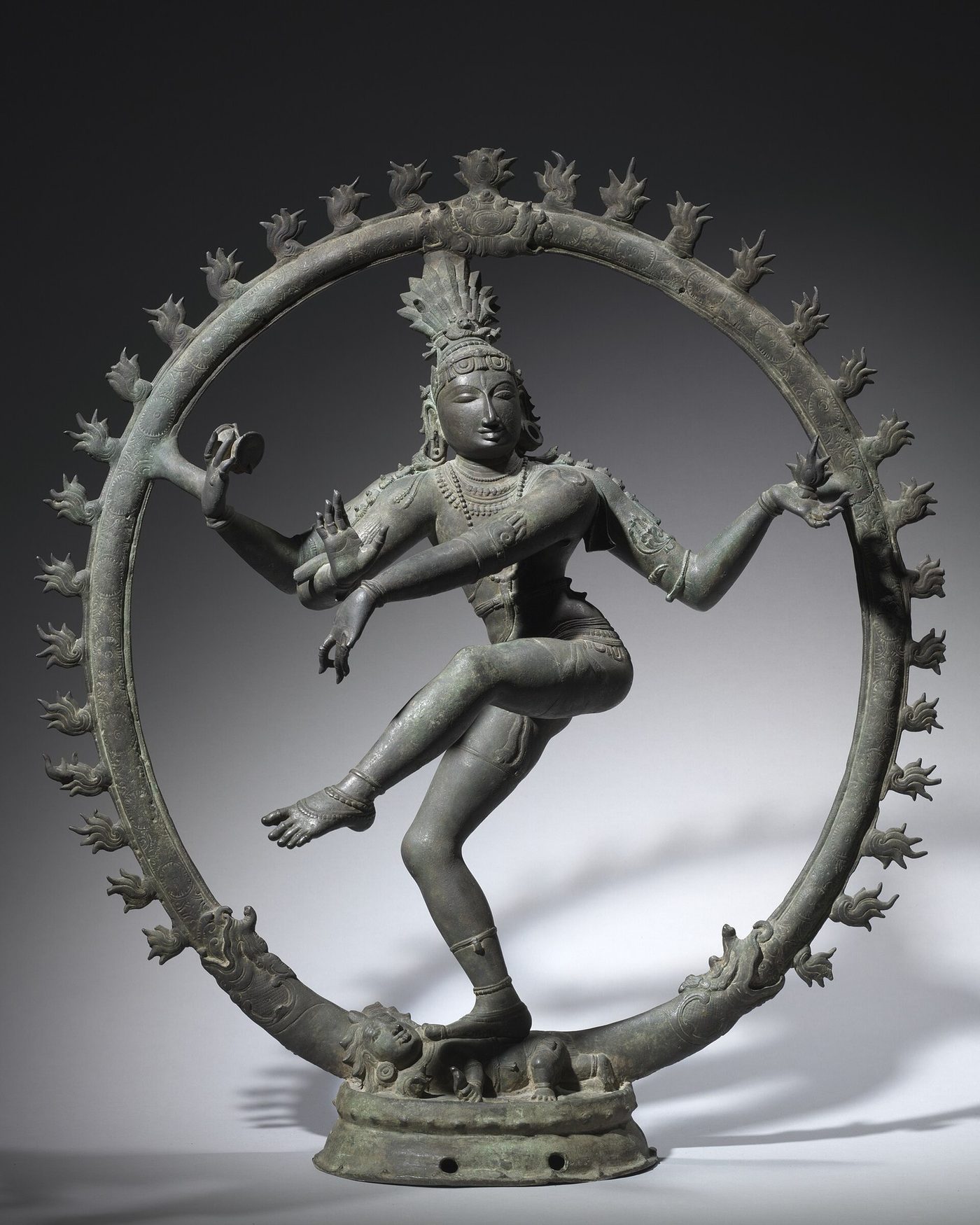

The Nāṭyaśāstra itself connects dance with Śiva: in its fourth chapter Śiva teaches the vigorous dance (tāṇḍava) to Bharata through his attendant Taṇḍu, and the goddess Pārvatī is credited with the delicate style later called lāsya. The pairing of a vigorous, “masculine” style with a delicate, “feminine” one has been used to classify movements and whole dance forms ever since, although in practice both styles are danced by men and women alike (Chapter 13).
1.6.3 Sacred and secular
Much Indian music and dance has a religious context: the temple ritual and festival, the Sufi assembly, the Sikh gurdwārā, the Vaiṣṇava kīrtan, the village goddess festival, the possession dances of Teyyam and Bhūta Kōla. Much of it, however, was always performed at courts, in salons and in public entertainments, and the treatises discuss performance mainly as an art that gives pleasure and aesthetic experience to cultivated spectators. Kapila Vatsyayan has argued that Indian music, dance, sculpture and architecture share common principles of form and a common religious and philosophical background (Vatsyayan 1983, 1968). Historians of the modern period have added that the emphasis on the spiritual and devotional character of the classical arts was greatly strengthened in the twentieth century, when it helped to make them respectable and to distinguish them from the arts of courtesans and from Western entertainment (Bakhle 2005; Meduri 2005). The two observations do not cancel each other. The arts were never merely religious or merely secular, and their meaning has always depended on who performed them, for whom and where.
1.7 Unity and Diversity
The traditions described in this volume share much: a theory of melody based on rāga, a theory of rhythm based on tāla, a vocabulary of gesture and expression derived in large part from the Nāṭyaśāstra and its successors, a repertoire of stories from the epics, the Purāṇas and devotional poetry, and the aesthetic ideal of rasa. They are also extremely diverse. Two systems of art music, Hindustani and Karnatak, have distinct rāgas, tālas, genres, instruments and institutions (Chapters 7 and 8). The Persianate and Sufi music of north India and the Deccan, with its Persian and Urdu poetry and its genres such as qawwālī and ghazal, and the Sikh kīrtan of the Punjab, are distinct traditions with their own histories, not merely variants of a “Hindu” music. The theatre of the subcontinent includes Sanskrit drama, the regional dance-dramas such as Yakṣagāna and the Bhāgavata Mēḷa, popular theatres such as Nauṭaṅkī, Tamāśā, Jātrā and Bhavāī, puppet theatres and the modern stage (Chapters 19 and 20).
Above all, the classical arts have always existed beside a vast world of folk and tribal music, dance and ritual performance: work songs, life-cycle songs, the epic singers of Rajasthan and Tamil Nadu, the Bāuls of Bengal, the harvest and festival dances of every region, the masked dance-dramas of Chhau and the ritual possession performances of Teyyam, and the music and dance of the Adivasi communities of central and northeastern India (Chapter 21) (Vatsyayan 1976; Blackburn et al. 1989). The division between “classical” (śāstrīya) and “folk” (lok) is in part the old distinction between mārga and deśī, but in its modern form it is largely a creation of the twentieth century, institutionalised by cultural academies and broadcasting; many forms now called classical grew out of regional practices, and many “folk” forms are technically demanding arts with their own specialists and teachers. Tribal knowledge and performance are treated more fully in Volume 23, Jana–Jāti.
1.8 The Dance Forms Treated in This Volume
Table 1.2 lists the dance forms that the Sangeet Natak Akademi recognises as “classical” (their centres are mapped in Figure 20.1), together with Chhau, which the Ministry of Culture also includes in its list; hence one often reads that India has “eight” or “nine” classical dances. The category is an institutional one: it was created in the decades after independence, and the criteria used — a connection with Sanskrit treatises, a codified technique, a lineage of teachers and a history of temple or court patronage — were applied gradually and not without controversy. Sattriya was added only in 2000. Many other forms, such as Yakṣagāna, Kūṭiyāṭṭam, the Bhāgavata Mēḷa or the Gauḍīya Nṛtya of Bengal, have comparable claims and are treated elsewhere in the volume (Vatsyayan 1974; Singha and Massey 1967; Ragini Devi 1972).
| Form | Region | Music | Characteristic features | Ch. |
|---|---|---|---|---|
| Bharatanāṭyam | Tamil Nadu | Karnatak | Half-seated stance (araimaṇḍi); aḍavu system; solo recital alternating nṛtta and abhinaya | 15 |
| Kathak | North India | Hindustani | Upright stance; rhythmic footwork with ankle bells; spins (cakkar); story-telling | 16 |
| Odissi | Odisha | Odissi | Square stance (cauka) and triple bend (tribhaṅga); Gītagovinda | 17 |
| Kuchipudi | Andhra Pradesh | Karnatak | Dance-drama of male Brahmin troupes; later solo form; taraṅgam | 17 |
| Kathakaḷi | Kerala | Kerala tradition (sōpānam) | Dance-drama; elaborate make-up and costume; gestures of the Hastalakṣaṇadīpikā | 18 |
| Mohiniyāṭṭam | Kerala | Karnatak / Kerala | Solo women’s dance; swaying, flowing movement | 18 |
| Manipuri | Manipur | Manipuri saṅkīrtana | Rāsalīlā and Lai Haraoba; soft, rounded movement; drum dances | 18 |
| Sattriya | Assam | Borgīt; khol drums | Monastic Vaiṣṇava dance of the sattras; recognised 2000 | 18 |
| Chhau | Jharkhand, Odisha, West Bengal | Drums and shawm (folk) | Martial, often masked dance-drama in three styles | 21 |
1.9 How This Volume Is Organised
The chapters fall into four groups, though the book is not formally divided into parts. The first three introduce the foundations. After this introduction, Chapter 2 describes the Nāṭyaśāstra: its date and structure, its origin myth, its theatre and preliminaries, its analysis of the body in movement — the karaṇas, cārīs and maṇḍalas — and its account of styles, conventions and dramatic genres. Chapter 3 presents the theory of rasa and bhāva and the four modes of acting (abhinaya) as they matter to performers; the philosophical debate about rasa is treated more fully in Volume 8, Kāvya Kalpalatā.
Chapters 4 to 11 are devoted to music. Chapter 4 traces the theory of pitch and melody from the Sāmaveda and the Nāṭyaśāstra’s śrutis, grāmas and jātis to the rāga and its modern classifications, and the history of musical notation. Chapter 5 explains the theory of rhythm and metre in the ancient texts and in the two modern systems. Chapter 6 follows the literature of music theory from the Dattilam and Mataṅga through the Saṅgītaratnākara and the regional treatises to Bhatkhande. Chapter 7 describes Hindustani music, its genres, gharānās and regional centres, its Persian literature, and the Persianate, Sufi and Sikh traditions of north India. Chapter 8 describes Karnatak music, its composers, its 72-mela system and its modern concert culture. Chapter 9 surveys devotional music across regions and religions: the Tamil temple hymns, the southern bhajana, the abhaṅg and kīrtan of Maharashtra, the temple music of the Puṣṭimārga, Bengali kīrtan, the Sikh scripture, the Shia majlis, and Jain and Newar Buddhist song. Chapter 10 treats the instruments, from the ancient classification into strings, winds, drums and solid instruments to the sitār, vīṇā, tablā and mṛdaṅgam. Chapter 11 follows the authored song of the modern regional languages: Rabīndrasaṅgīt and the other song-makers of Bengal, the songs of Kazi Nazrul Islam, the Bengali modern and mass song, the Marathi stage song and bhāvgīt, the Assamese song of Jyotiprasad Agarwala, Bishnu Rabha and Bhupen Hazarika, the southern lyric and the Urdu ghazal-song.
Chapters 12 to 18 are devoted to dance. Chapter 12 introduces the Abhinayadarpaṇa and the later dance treatises and their account of the head, eyes, neck and stances. Chapter 13 explains the grammar of pure and expressive dance shared by the classical forms. Chapter 14 sets out the language of hand gestures. Chapters 15, 16, 17 and 18 describe the classical forms: Bharatanāṭyam; Kathak; Odissi and Kuchipudi; and Kathakaḷi, Mohiniyāṭṭam, Manipuri and Sattriya.
The last five chapters turn to theatre and to the living landscape of performance. Chapter 19 covers Sanskrit drama, its dramaturgy and its performance, Kūṭiyāṭṭam, puppet theatre, the Parsi and other company theatres, and modern Indian theatre. Chapter 20 describes the regional popular theatres — Yakṣagāna, Terukkūttu, Jātrā, Tamāśā, Nauṭaṅkī, Bhavāī, the Rāmlīlā and Rāslīlā and others — and their performers and patrons. Chapter 21 surveys folk and tribal music, dance and ritual performance. Chapter 22 turns to the North-East and the Himalaya: the songs and dances of Assam beyond the sattras, the hill peoples of Nagaland, Meghalaya, Mizoram, Tripura and Arunachal Pradesh, Sikkim and the Darjeeling hills, the ritual music and masked dance of Tibetan Buddhism, the Sufi music of Kashmir, and the drummers and deity processions of Himachal Pradesh and Uttarakhand. Chapter 23 considers the modern and contemporary period: institutions and patronage, recording, radio and cinema, the history of music and dance education, the diaspora, contemporary dance, the international recognition of Indian arts and the debates that surround them.
Related subjects are treated in other volumes of the series: poetics, the theory of rasa and Sanskrit and Tamil literature in Volume 8, Kāvya Kalpalatā; language, phonetics and prosody in Volume 10, Śabda Vidyā; temple architecture and sculpture, including the sculptural evidence for dance, in Volume 16, Vāstu–Śilpa; the yogic body in Volume 5, Yoga Taraṅgiṇī; and tribal and folk knowledge in Volume 23, Jana–Jāti.
Note: A note on names and spellings
Sanskrit, Pali and Prakrit words and pre-modern names are given in the International Alphabet of Sanskrit Transliteration (IAST), and Tamil words in a standard transliteration (with ḻ and ṉ). Names of modern persons, institutions and places are given in their usual English spelling (Rukmini Devi Arundale, Kalakshetra, Thanjavur). For the dance forms the volume uses Bharatanāṭyam, Kathak, Odissi, Kuchipudi, Kathakaḷi, Mohiniyāṭṭam, Manipuri and Sattriya. Hindustani and Persian terms are given in a simplified transliteration (khayāl, gharānā, ṭawāʾif). Chapter numbers of the Nāṭyaśāstra follow the edition and translation of Manomohan Ghosh (Ghosh 1950); other editions number some chapters and verses differently.
Further Reading
Rowell (1992) is the best introduction to early Indian music and its thought, and Widdess (1995) to the early history of rāga. Vatsyayan (1968) and Vatsyayan (1974) remain the standard surveys of classical dance in literature, sculpture and practice, and Vatsyayan (1976) of folk dance; Bose (1991) examines the Sanskrit dance texts. Richmond et al. (1990) surveys the theatre traditions. For the social history of performers, begin with Neuman (1980) and Bakhle (2005) for north India and Soneji (2012), Srinivasan (1985) and Weidman (2006) for the south; Schofield (2010) rethinks the idea of the “classical” in Mughal music. Smith (1996) and Coomaraswamy (1918) discuss the dance of Śiva.