Chapter 21: Legacies and Modern Relevance
Chapter Overview
This chapter asks what survived of the commercial and maritime history traced in this volume, and how that history is used today. It follows the merchant communities and indigenous bankers who adapted to colonial rule and became modern business groups; the economic nationalism of the swadeshi movement and of Gandhi and Kumarappa; the cooperative movement; the legal protection of craft names as geographical indications; and the revival of interest in India’s maritime past, from sail-training voyages to new museums. It closes with a caution about the misuse of economic history in popular argument and with a conclusion to the volume as a whole.
Every society uses its past, and the economic past is used more than most. Politicians, business writers and textbook authors invoke the Arthaśāstra, the guilds, the hundī or the Chola fleets to support arguments about the present. Some of these uses are illuminating; many are not. A historically grounded account of legacies has to distinguish three things: institutions and communities that really did continue, sometimes in changed form, into the twentieth century; modern movements that deliberately looked to the past for inspiration; and claims of continuity or priority that the evidence does not support. The colonial transformation of the economy, which lies between the earlier chapters and this one, is treated in Chapter 19.
21.1 Merchant Communities and Modern Business
The clearest continuity between pre-colonial and modern commerce lies not in particular institutions but in the merchant communities themselves. Groups that had traded and lent money under the Mughals and the regional states of the eighteenth century adapted to colonial rule, moved into new activities and new regions, and in several cases became industrial business houses in the twentieth century.
The Marwaris. Traders and bankers from Rajasthan, many of them Jain or Vaiṣṇava, had long served rulers as financiers; the house of Jagat Seth at Murshidabad was of Marwari origin (Section 6.6.1). Their migration to Calcutta and the towns of the east, and their move from brokerage and speculation into jute and cotton mills from the First World War onward, are traced in Sections 6.6.3 and 19.11.3; the Birla family, which founded a jute mill near Calcutta in 1919, is the best-known example (Timberg 1978).
The Nattukottai Chettiars. The Chettiar banking network that followed the British empire across the Bay of Bengal, and its collapse in Burma after the depression of the 1930s, the Japanese invasion of 1942 and Burmese land legislation after independence, is described in Section 6.6.4 (Rudner 1994). Its history shows both the reach of an indigenous banking network and its dependence on colonial law and markets.
Gujarati, Parsi, Sindhi and other networks. Parsi merchants of Bombay prospered as shipbuilders, in the China trade and then in cotton textiles and, with the Tata family, in steel; in Ahmedabad Gujarati Jain and Vaiṣṇava merchant families financed and ran the mills (Section 19.11). Gujarati and Kutchi traders, Hindu (Bhatia, Lohana) as well as Muslim (Khoja, Bohra), became prominent in the trade of Zanzibar and the East African coast, and Sindhi merchants from Shikarpur and Hyderabad built networks that reached from Central Asia to Panama (Markovits 2000).
Rajat Kanta Ray called the world in which these communities operated “the bazaar”: an Asian sector of credit, wholesale trade and remittance, distinct from the European firms and banks that dominated foreign trade and large-scale finance. In his account the bazaar did not simply decline under European domination but survived, and in some ways grew, between 1800 and 1914 (Ray 1995). C. A. Bayly showed how north Indian merchant families and their corporate bodies shaped town life and politics in the decades of transition to British rule (Bayly 1983).
Many of these families also continued older patterns of religious giving (Chapter 9). Chettiar firms financed the building and renovation of temples in Tamil Nadu and wherever they settled overseas; Marwari, Gujarati and Jain merchants endowed temples, rest houses, schools and hospitals; and Parsi philanthropists founded educational and medical institutions in Bombay. Such giving brought merit and status, reinforced the standing of a firm within its community, and, in the colonial period, was shaped by new laws on charitable trusts (Birla 2009).
Three cautions are needed. First, these continuities are of communities, family firms and networks, not of the ancient śreṇī (Chapter 4); there is no evidence of an unbroken institutional line from early historic guilds to modern business houses. Second, the communities were shaped by colonial law as much as by tradition. Ritu Birla has shown how colonial legislation on income tax, charitable trusts and speculation defined the “Hindu undivided family” and separated approved from disapproved forms of “vernacular” capitalism (Birla 2009). Third, community-based business was exclusive by design. Its strengths, trust and shared information within a caste or sect, were the other side of its closure to outsiders.
21.1.1 Indigenous Banking after 1800
The hundī and the indigenous bankers who issued and discounted it remained essential to inland trade well into the twentieth century; the banking enquiries of 1929–31 and the Reserve Bank’s unsuccessful attempt to bring them into a regulated system are described in Section 6.8.2. They declined slowly as joint-stock and, after 1969, nationalised banks spread. Informal remittance through trusted correspondents survives as hawala, which in India is illegal outside authorised channels. Modern electronic payments, like the hundī, move value without moving coin, but there is no institutional connection between them.
21.2 Swadeshi and Gandhian Economics
The first systematic modern use of India’s economic past was nationalist: Naoroji, Ranade and Dutt pointed to the earlier prosperity of Indian crafts and trade as evidence of what colonial rule had cost, and the swadeshi movement of 1905 turned the argument into boycott and Indian enterprise (Sections 19.4 and 19.14) (Naoroji 1901; Dutt 1902; Chandra 1966).
M. K. Gandhi gave swadeshi a different and more radical meaning. In Hind Swaraj (1909) he rejected industrial civilisation itself, and from around 1920 he made hand-spinning and hand-woven cloth (khādī) the centre of a programme of village reconstruction and political mobilisation. The spinning wheel symbolised self-reliance, the dignity of manual labour and the recovery of the livelihood that he believed machine-made imports had taken from India’s spinners and weavers, most of them women and poor households. Gandhi also proposed that the rich should hold their wealth as “trustees” for society.
The economist J. C. Kumarappa, secretary of the All-India Village Industries Association founded by Gandhi in 1934, developed these ideas into an economic theory. In Economy of Permanence (1945) he contrasted an economy of “transience”, which consumed non-renewable resources and depended on violence and centralisation, with an economy of “permanence” modelled on natural cycles, based on local production for local needs (Kumarappa 1945). His ideas have been compared with later environmental economics, and E. F. Schumacher quoted him in Small Is Beautiful (1973).
The Gandhian programme had critics from the start. Jawaharlal Nehru and the planners of independent India chose rapid industrialisation, with village and small industries protected but secondary (Chapter 20); the Khadi and Village Industries Commission, set up under an Act of 1956, institutionalised the Gandhian legacy within that framework. B. R. Ambedkar rejected the idealisation of the village altogether. In the Constituent Assembly on 4 November 1948 he asked: “What is the village but a sink of localism, a den of ignorance, narrow-mindedness and communalism?” For Ambedkar the self-sufficient village economy was also the setting of caste hierarchy and untouchability. Any use of the village or craft economy as a model has to reckon with that criticism.
21.3 Cooperatives
The cooperative movement in India began under colonial law, with the Co-operative Credit Societies Act of 1904 and the wider Co-operative Societies Act of 1912, which were intended to free cultivators from dependence on moneylenders. Its best-known success came after independence. The Kaira District Co-operative Milk Producers’ Union, founded at Anand in Gujarat in 1946 and associated with the brand name Amul and with Verghese Kurien, organised village milk producers’ societies into a district union; its model was extended across India by the National Dairy Development Board’s Operation Flood from 1970. The Self-Employed Women’s Association (SEWA), founded by Ela Bhatt in Ahmedabad in 1972, organised women in the informal sector and established its own cooperative bank in 1974.
Cooperatives are sometimes presented as a revival of the ancient guilds. As an analogy the comparison has some value: both were associations of producers or traders that pooled resources, regulated their members and dealt collectively with the state and the market, and the dharmaśāstra texts recognised the binding force of guild rules (Chapter 4). But the differences are as important as the similarities. Early guilds were often hereditary and linked to caste, their headmen were not elected on the principle of one member, one vote, and they did not aim to include the poor. Modern cooperatives grew out of a European model brought to India by colonial officials and adapted by Indian reformers; they are not descendants of the śreṇī.
21.4 Crafts and Geographical Indications
Regional names have long served as marks of quality. The Arthaśāstra’s chapter on the treasury distinguishes fine cloths by their regions of origin, among them Vaṅga, Puṇḍra and Kāśi (AŚ 2.11), and the Periplus names cloth by the markets from which it came (Chapter 8). Modern law gives such names protection. Under the World Trade Organization’s agreement on intellectual property (TRIPS, 1995) member states had to protect geographical indications, and India passed the Geographical Indications of Goods (Registration and Protection) Act in 1999; it came into force in 2003. The first product registered under it was Darjeeling tea. Others include Pochampally ikat, Kanchipuram silk and Mysore silk, and several hundred products are now registered.
A geographical indication protects a name, not a technique. It prevents goods made elsewhere from being sold as, say, Kanchipuram silk, and it can help producers to command a premium. Whether it helps the weavers or tea workers themselves depends on who holds and enforces the registration and on how the gains are shared. The list also shows the limits of heritage claims. Darjeeling tea is a product of colonial plantations established from the mid-nineteenth century on land and labour organised by British companies; its reputation is real, but it is not ancient. The history of crafts, and of the effects of colonial rule on them, is treated in Chapter 8, Chapter 19 and Volume 17, Śilpa–Kāru.
21.5 The Arthaśāstra Today
Since R. Shamasastry published the text in the early twentieth century, the Arthaśāstra has been read as evidence of an indigenous science of statecraft and economics, and in recent decades it has become popular in management literature and political rhetoric (Shamasastry 1915; Trautmann 2012). Its superintendents of markets, weights and customs can usefully be compared with modern regulators, as long as the comparison is understood as an analogy that brings out differences as well as similarities. The text describes a royal state that ran its own monopolies, used spies and agents provocateurs, put convicts and slaves to forced labour, and graded punishments by varṇa. The verse that is most often quoted from it, that the king’s happiness lies in the happiness of his subjects (AŚ 1.19.34), stands in the same work as detailed advice on secret assassination. It belongs to the early centuries CE (Chapter 2), and it did not anticipate modern economics. It is best read as what it is: a remarkable treatise on how a king might enrich and secure his realm.
21.6 The Sea in Modern India
India has a coastline of about 7,500 kilometres by the long-standing official measure (about 11,100 kilometres by the finer method of measurement adopted in 2024), including its island territories, and an exclusive economic zone of about 2.02 million square kilometres. For much of the twentieth century, however, the maritime past played little part in national self-image. Indian-owned shipping had declined under colonial rule (Chapter 19), the Royal Indian Navy became the Indian Navy only in 1950, and historical writing on the Indian Ocean was largely the work of a small number of specialists, among them Ashin Das Gupta, K. N. Chaudhuri, Sinnappah Arasaratnam, Himanshu Prabha Ray and Michael Pearson (Das Gupta 1979; Chaudhuri 1985; Arasaratnam 1994; Ray 1994; Pearson 2003). Since the 1990s the sea has become much more prominent in public culture.
One institutional link with the colonial period is commemorated every year: National Maritime Day (5 April) marks the sailing of the Scindia company’s Loyalty from Bombay to London in 1919 (Section 19.14). Indian shipping companies struggled against conference rates and the competition of British lines until independence; afterwards the government reserved coastal trade for Indian ships and created the state-owned Shipping Corporation of India (1961). The revival of Indian shipping after 1947 was thus the work of nationalist entrepreneurs and the state, not the reawakening of an older tradition.
21.6.1 Sail Training and Ocean Voyages
The Indian Navy has used sail-training vessels both for training and for long-distance voyages with a symbolic purpose. The sloop INSV Mhadei, built in Goa and commissioned in 2009, carried Commander Dilip Donde on the first solo circumnavigation by an Indian (2009–10) and Lieutenant Commander Abhilash Tomy on a solo non-stop circumnavigation (2012–13). Her sister vessel INSV Tarini, commissioned in 2017, is named after the Tara Tarini hill shrine near Berhampur in Ganjam district, Odisha, whose goddesses are associated in local tradition with seafarers. Between September 2017 and May 2018 a crew of six women officers, led by Lieutenant Commander Vartika Joshi, sailed Tarini round the world from Goa, with stops in Australia, New Zealand, the Falkland Islands and South Africa, in the voyage called Navika Sagar Parikrama; a second voyage by two women officers followed in 2024–25. These voyages are achievements of modern seamanship. They are linked to the past by their names and symbols, not by any continuous tradition of Indian ocean sailing.
A different kind of experiment is the stitched ship. In 2025 the Navy inducted INSV Kaundinya (Figure 21.1), a sailing vessel built in Goa by traditional shipwrights with hull planks sewn together rather than nailed, as an attempt to reconstruct an early Indian Ocean ship; according to the Navy, its design drew on a ship depicted in the paintings at Ajanta (Section 13.2), and it is named after the Kauṇḍinya of the Funan foundation legend (Chapter 16). Like the Borobudur replica, it can show what such a design is capable of, but not exactly how ancient ships were built or sailed (Chapter 13).
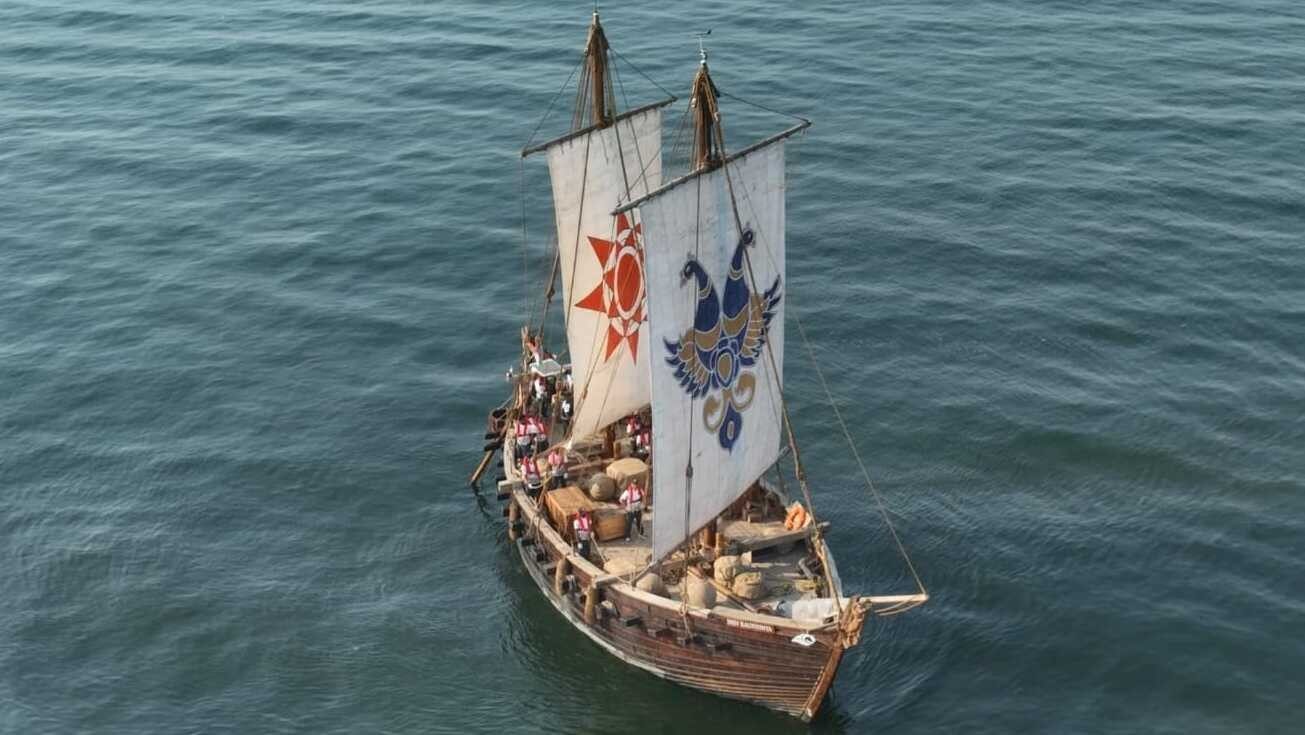

The Navy has also adopted symbols from the Indian past. Its motto, śaṃ no varuṇaḥ (“may Varuṇa be gracious to us”), is taken from a Vedic invocation best known from the opening of the Taittirīya Upaniṣad. In 2022 it adopted a new ensign that dropped the St George’s cross inherited from the Royal Navy and placed the naval crest in an octagonal frame described as inspired by the seal of Śivājī.
21.6.2 Museums, Festivals and Ports
Maritime history is presented to the public in a growing number of places, among them the site museum at Lothal, the submarine INS Kursura preserved as a museum at Visakhapatnam, and the collections of the Maritime History Society in Mumbai. A National Maritime Heritage Complex at Lothal, announced by the central government in 2019 and under construction in the 2020s, is planned to present the maritime history of India from the Harappan period onward. The function of the Lothal basin, which such a complex is likely to present as a dock, remains debated among archaeologists (Section 11.3). Popular memory of the sea also survives in festivals such as the Bali Jatra held at Cuttack on Kārttika Pūrṇimā, which commemorates the voyages of Odia merchants to Southeast Asia (Section 15.2.7).
The state’s interest in the sea is also economic and strategic. The Sagarmala programme, launched in 2015, aims at port modernisation, better connections between ports and the hinterland, port-led industrial development and coastal shipping, and its publicity invokes the maritime past. Such programmes are policy choices for the present. The history in this volume can explain why India’s ports and shipping developed as they did, but it does not prescribe what should be built now.
21.7 Uses and Misuses of the Past
Popular writing on India’s economic history often turns the evidence into a story of a golden age, a fall and a coming restoration. India is described as the “golden bird” (sone kī ciṛiyā) whose wealth attracted invaders; the Indian Ocean is described as an Indian lake; and India is credited with the first dock, the first compass, the first bills of exchange, the first joint-stock companies or the first insurance. This volume has examined such claims one by one and found most of them unsupported or misleading: the Lothal basin is of debated function (Chapter 11); the “matsya-yantra” compass rests on thin and late evidence (Chapter 14); nothing shows that the hundī preceded European bills of exchange, and the partnerships and sea loans described in the law books were not joint-stock companies or insurance (Chapters 6 and 15); and the Indian Ocean was shared by Arab, Persian, Gujarati, Tamil, Chinese, Southeast Asian, Swahili, Armenian and Jewish merchants (Chapter 12). The “Greater India” picture of Indian colonies in Southeast Asia has likewise given way to an account of local agency (Chapter 16).
The figures most often quoted in support of the golden-age story are Angus Maddison’s estimates of India’s share of world output: roughly a quarter around 1500–1700, falling to about 4 per cent by 1950 (Maddison 2001, 2006). As Chapters 18 and 19 explain, these are back-projections rather than measurements, a large share mainly reflects a large population, and the estimates of income per head by Broadberry, Custodis and Gupta, and the contrary arguments of Parthasarathi, tell a more complicated story (Broadberry et al. 2015; Parthasarathi 2011; Roy 2012). None of these positions supports the image of a uniquely rich India; all of them treat the question as one of evidence.
Archaeology can be misused in the same way. Underwater work off Dwarka since the 1980s has recorded stone structures and anchors whose dates and interpretation are disputed, and claims made in the early 2000s for a submerged “city” many thousands of years old in the Gulf of Khambhat rested on objects dredged from the seabed without archaeological context; most archaeologists have rejected them. Such finds deserve careful investigation, but they cannot be used to prove the historicity of epic cities or to push the history of Indian seafaring back by millennia.
The same caution applies to the colonial period. That colonial rule imposed heavy costs on India is not in doubt; how heavy, through which mechanisms, and how they compare with other influences on the economy are matters of continuing debate among historians (Chapter 19). Single figures for the total “drain” circulate widely, but they are contested estimates, and polemical works written for a general readership, however forceful, are not sources of data (Patnaik 2017; Tharoor 2017).
Finally, a heritage that is claimed for one community or one religion is a distorted heritage. The commercial and maritime history of India was made by Hindus, Jains, Buddhists, Muslims, Christians, Jews and Parsis; by the Muslim Māppiḷa merchants and the Kuñjāli Marakkār admirals of Calicut who fought the Portuguese, the Siddi admirals of Janjira, of African descent, who served the Mughals, and the Maratha fleets of Kānhojī Āṅgre, whom the English called a pirate and Marathi tradition remembers as a hero. It was also made by people whose names are rarely recorded: weavers, porters, sailors, divers and the enslaved. In the prologue to his Mālavikāgnimitra (1.2), Kālidāsa observes, of poetry, that not everything is good merely because it is old, nor is a poem to be blamed merely because it is new; the wise examine both and choose. The same principle applies to the uses of economic history.
21.8 Conclusion to the Volume
This volume has followed the economic life of South Asia over more than four thousand years, from the standardised weights of the Harappan cities to the colonial economy. Its first theme has been institutions. Early Indian texts, above all the Arthaśāstra and the dharmaśāstras, show a sophisticated understanding of markets, prices, interest, contracts and taxation, embedded in a social order of varṇa and royal power. Guilds and merchant associations regulated their members and dealt with kings; coinage, from punch-marked silver to Mughal rupees, supported exchange over wide areas; credit instruments such as the hundī allowed merchants to move funds across the subcontinent. These institutions changed constantly. They were not a fixed “Indian system” but a set of practices that rulers, merchants and communities adapted to new conditions.
The second theme has been networks. Overland, Indian merchants traded across the subcontinent and into Central Asia, Iran and China, and Buddhist monks travelled with them. By sea, the merchants of Gujarat, Malabar, the Coromandel coast and Bengal took part in a trade that linked East Africa and the Mediterranean with Southeast Asia and China. The most successful of these networks were built on kinship, caste, religion and language, which created trust over long distances; they were also exclusive, and they depended on the labour of many people who appear in the sources only as weavers, porters or slaves.
The third theme has been the sea. The monsoon set the rhythm of the Indian Ocean trade, and Indian coasts and ports, from Bharukaccha and Muziris to Cambay, Calicut, Nāgapaṭṭinam and Surat, were among its busiest places. But the ocean was never an Indian lake. Arabs, Persians, Gujaratis, Tamils, Chinese, Malays, Javanese, Swahili, Armenians and Jews all sailed it, and its ports were governed by rulers who generally welcomed merchants of every faith. India’s influence on Southeast Asia came through the choices of Southeast Asian rulers, not through conquest, and goods, ideas and people flowed in both directions.
The last theme has been rupture. From the late eighteenth century the East India Company and then the British Crown transformed India’s place in the world economy: Indian textiles lost their export markets and much of their home market to machine-made cloth, though handloom weaving survived on a large scale; Indian shipping declined; and part of India’s export earnings went to meet payments in Britain, the “home charges” and remittances that the nationalists called the drain. How far these changes impoverished India, how far they reflected wider forces, and what the counterfactual might have been are questions on which historians from Naoroji and Dutt to Morris, Bagchi and Roy have disagreed (Naoroji 1901; Morris 1963; Bagchi 1976; Roy 2000). The merchant communities that adapted and survived, the nationalist movements that drew on memories of earlier prosperity, and the modern uses of the maritime past described in this chapter all belong to the aftermath of that rupture. Understanding the history accurately, including its debates and its uncertainties, is the best service it can render to the present.
Further Reading
On merchant communities and business history, see Timberg (1978), Rudner (1994), Markovits (2000) and Ray (1995); on colonial law and Indian capitalism, Birla (2009). Tomlinson (1993) and Roy (2012) are good surveys of the modern Indian economy in long perspective, and Broadberry et al. (2015) and Parthasarathi (2011) represent the two sides of the debate on divergence. Kumarappa (1945) is the classic statement of Gandhian economics, and Chandra (1966) the standard study of early economic nationalism. For the Indian Ocean in long perspective, Pearson (2003) is the best introduction.