Chapter 19: The Company and the Codes: The Making of Anglo-Indian Law, 1772–1947
From the late eighteenth century the British East India Company, and then the Crown, built a new legal order in India. It claimed to apply “Hindu law” and “Muhammadan law” to Hindus and Muslims in matters of family and religion, while replacing both with English-derived codes in most other fields. The personal law system of modern India, discussed in Chapter 20, is the product of this history.
The Company did not legislate on a blank page. In Bengal and the other Mughal provinces it took over a working legal order — qāḍīs’ courts and muftīs, Mughal regulations and revenue records, Brahmin experts in Dharmaśāstra and the councils of castes, villages and merchants — described in the two preceding chapters (Chapters 17 and 18). This chapter describes how the Company’s courts translated, selected and transformed that inheritance into “Anglo-Hindu” and “Anglo-Muhammadan” law, and how codification and social legislation reshaped Indian law between 1772 and independence. The subject has a large literature of its own; the aim here is to give an accurate outline and to correct some errors common in popular accounts. Figure 19.1 sets out the main milestones.
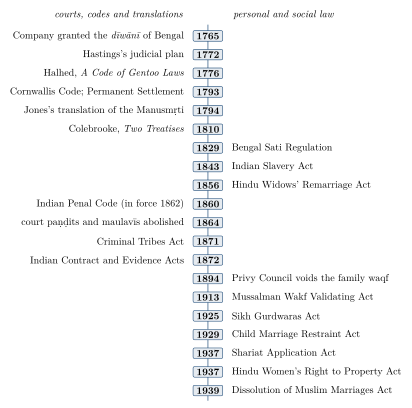
19.1 Hastings’s Plan of 1772
In 1765 the Mughal emperor granted the East India Company the dīwānī — the right to collect the revenue and administer civil justice — of Bengal, Bihar and Orissa. In 1772 the governor Warren Hastings introduced a judicial plan establishing civil and criminal courts in each district under Company officers. One clause of the plan laid down the principle that would shape Indian family law for two centuries:
In all suits regarding inheritance, marriage, caste, and other religious usages or institutions, the laws of the Koran with respect to Mahometans, and those of the Shaster with respect to Gentoos, shall be invariably adhered to; on all such occasions, the Moulvies or Brahmins shall respectively attend to expound the law…
The clause assumed that there existed a “law of the Shaster” for Hindus (“Gentoos”) analogous to the “law of the Koran” for Muslims, that it was contained in texts, and that learned men could state it reliably. Those assumptions, as many historians have shown, simplified a far more varied reality in which caste, regional and family custom, the decisions of local bodies and the opinions of many scholars all played a part (Derrett 1968; Cohn 1996).
19.2 Translating the Śāstras
19.2.1 Halhed’s Code of Gentoo Laws
To give the new courts a text, Hastings commissioned a group of eleven paṇḍits to compile a digest of Hindu law. The Sanskrit work they produced in 1773–75, the Vivādārṇavasetu (“Bridge across the Ocean of Disputes”), was translated into Persian, and from Persian into English by the young Nathaniel Brassey Halhed, who published it in London in 1776 as A Code of Gentoo Laws, or, Ordinations of the Pundits (Halhed 1776; Rocher 1983). As a translation of a translation, made by a young man who did not yet know Sanskrit, it was of limited legal value, but it was the first attempt to present Hindu law to English readers as a “code”.
19.2.2 Jones, Colebrooke and the Digest
Sir William Jones, who arrived in Calcutta as a judge of the Supreme Court in 1783 and founded the Asiatic Society of Bengal in 1784, distrusted the paṇḍits on whom the judges depended and resolved to learn Sanskrit and to produce an authoritative digest. His translation of the Manusmṛti appeared in 1794 as Institutes of Hindu Law: or, the Ordinances of Menu, following the commentary of Kullūka (Jones 1794). He also translated works of Islamic inheritance law. At his instigation the paṇḍit Jagannātha Tarkapañcānana compiled a new Sanskrit digest, the Vivādabhaṅgārṇava; after Jones’s death in 1794, Henry Thomas Colebrooke translated it as A Digest of Hindu Law on Contracts and Successions (1797–98) (Colebrooke 1798). Colebrooke’s Two Treatises on the Hindu Law of Inheritance (1810), translations of the Dāyabhāga and of the inheritance chapter of the Mitākṣarā, became the most important authorities for the courts (Colebrooke 1810). Jones’s conviction that Sanskrit was kin to Greek and Latin, and that the Manusmṛti was among the oldest law codes of mankind, belonged to a wider Orientalist project whose effects on British ideas of India’s past Thomas Trautmann has traced (Trautmann 1997). (The Vivādārṇavasetu translated by Halhed and the Vivādabhaṅgārṇava translated by Colebrooke are different works, and should not be confused.)
19.2.3 Islamic Law in English
Parallel works made Islamic law available to British judges. Charles Hamilton’s The Hedaya (1791) was a translation, made from a Persian version, of the twelfth-century Ḥanafī manual al-Hidāya of al-Marghīnānī. Jones translated the Sirājiyya on inheritance (1792). Later works drew on the Fatāwā-i ʿĀlamgīrī. Scott Kugle has shown how translation, selection and the courts’ reliance on precedent transformed a flexible jurists’ law into “Anglo-Muhammadan law”, narrowing it to personal matters and stripping it of its own interpretive methods (Kugle 2001).
19.3 The Company’s Courts
The judicial system created under Hastings was repeatedly reorganised. A Supreme Court of Judicature, staffed by English judges and applying English law to Europeans and to the inhabitants of Calcutta, was established by the Regulating Act of 1773, and conflicts between it and the Company’s own courts were a feature of the following decades. In the Company’s territories, district civil courts (dīwānī adālat) and criminal courts (faujdārī adālat) were supervised by superior appellate courts at the capital. Where no rule of Hindu or Islamic law applied, the courts were directed to decide according to “justice, equity and good conscience”, a formula that allowed English rules to enter Indian law. The “Cornwallis Code” of 1793 consolidated the regulations of the Bengal government; the same year saw the Permanent Settlement, which fixed the land revenue of Bengal in perpetuity and recognised the revenue-collecting zamīndārs as proprietors of the land — a transformation of rights in land with consequences comparable to any change in personal law (Cohn 1996).
The Permanent Settlement deserves emphasis because it shows how a colonial reform of property law could transform rural society as profoundly as any change in religious law. Ranajit Guha showed that the idea of the settlement grew out of European theories of property and political economy, which identified the zamīndārs as the natural owners of the soil and expected them to become improving landlords (Guha 1963). In practice, the rigid revenue demand led to the sale of many old estates, the rise of new landholders, and the weakening of the customary rights of cultivators, which later tenancy legislation tried, with limited success, to restore. Other systems of settlement — with individual cultivators (raiyatwārī) in much of Madras and Bombay, and with village bodies (mahālwārī) in parts of the north — were introduced in the following decades; they too were colonial creations, not continuations of Mughal practice.
In criminal justice, the Company at first retained Islamic law as administered by qāḍīs and muftīs in its courts, but progressively modified it by regulation: it limited the role of the victim’s heirs in homicide cases, abolished mutilation, and substituted imprisonment and transportation. Radhika Singha has shown how this process produced a “despotism of law”, in which the colonial state claimed to rule through law while reserving extraordinary powers to itself (Singha 1998); Elizabeth Kolsky has shown how the same courts treated violence by Europeans against Indians with conspicuous leniency (Kolsky 2010). The Charter Act of 1833 created a Law Member of the Governor-General’s Council and a Law Commission, which began the work of codification; the High Courts established in 1862 in Calcutta, Bombay and Madras united the Crown’s and the Company’s systems.
19.4 Anglo-Hindu Law
19.4.1 Paṇḍits, Judges and Precedent
For several decades the Company’s courts employed court paṇḍits and maulavīs to state the law in each case. British judges suspected them of corruption and inconsistency, and as translations and reported decisions accumulated, the judges relied increasingly on these instead. In 1864 the posts of law officers were abolished. Thereafter “Hindu law” was what English and, increasingly, Indian judges and lawyers found in translations, textbooks such as John Mayne’s Treatise on Hindu Law and Usage (1878), and above all in the reported decisions of the High Courts and of the Judicial Committee of the Privy Council in London, which was the final court of appeal. J. D. M. Derrett called the result “Anglo-Hindu law”: a body of law with Sanskrit roots but English methods, in which precedent replaced the commentator and the territorial “schools” of the Mitākṣarā and Dāyabhāga (Chapter 11) replaced the flexible regional traditions of the śāstras (Derrett 1961, 1968).
19.4.2 Effects
Historians have identified several consequences of this process.
-
Textualisation. Law was located in a small number of translated texts — the Manusmṛti, the Mitākṣarā, the Dāyabhāga and a few digests — rather than in the living practice of communities. Richard Lariviere described the irony that śāstric texts, which had recorded and legitimated custom, were treated as statutes (Lariviere 1989).
-
Brahmanisation. Because the texts were Brahmanical and custom was hard to prove (Chapter 16), the courts often applied Brahmanical norms — for example on marriage, adoption and women’s property — to communities that had not followed them, including many lower castes that had allowed divorce and widow remarriage (Galanter 1989).
-
Rigidity. Precedent fixed rules that commentators had previously been free to reinterpret. The courts held, for instance, that a woman’s inherited property was a limited estate and not her strīdhana, rejecting the Mitākṣarā’s wider view (Chapter 15).
-
Religion as the basis of law. The division of personal law by religion — “Hindu”, “Muhammadan” — created sharper legal boundaries between communities than had existed, and made religious identity the basis of legal status in family matters. Bernard Cohn and Nicholas Dirks have argued that colonial knowledge in general, including the census and ethnography, made caste and religion more rigid and more central to Indian society than before (Cohn 1996; Dirks 2001).
These criticisms should not obscure other effects. Colonial courts also provided forums in which lower-caste and women litigants could sometimes assert rights against caste authorities, and the legislature, under pressure from Indian reformers, enacted changes that the śāstric tradition would not have made.
19.5 Anglo-Muhammadan Law
19.5.1 From Law Officers to Precedent
Islamic law in the Company’s courts went through the same transformation as Hindu law. Until 1864 maulavīs served as law officers who stated the rule in each case; thereafter judges relied on translations, textbooks and reported decisions. Besides Hamilton’s Hedaya, the main sources in English were Neil Baillie’s Digest of Moohummudan Law (1865–69), which drew its Ḥanafī part largely from the Fatāwā-i ʿĀlamgīrī and added a volume on Shīʿī law, and the textbooks of Indian and British lawyers, among them Syed Ameer Ali, a judge of the Calcutta High Court and later the first Indian member of the Judicial Committee of the Privy Council. Roland Wilson’s textbook (1894) popularised the name “Anglo-Muhammadan law” for the resulting body of law. The field it covered shrank as the codes advanced: Islamic criminal law, which the Company had retained in modified form, gave way to the Penal Code in 1862, and the Contract and Evidence Acts of 1872 displaced the jurists’ rules in those fields. What remained was the law of marriage, divorce, dower, maintenance, guardianship, inheritance, gift, waqf and pre-emption (Kugle 2001; Fyzee 1949).
The courts’ method changed the character of this law. A judge who found a rule in Baillie or the Hedaya applied it as an English judge applied a statute or a precedent; he could not, as a qāḍī could, choose among the opinions of the school or consult a muftī on a new problem. Scott Kugle has argued that the result was a law at once more rigid and less Islamic than the fiqh it claimed to administer, since its interpretive authority had passed from the jurists to the colonial judiciary (Kugle 2001).
19.5.2 The Family Waqf
The clearest conflict between the courts and the jurists concerned the family endowment (Chapter 18). In Abul Fata Mahomed Ishak v. Russomoy Dhur Chowdhry (1894) the Privy Council held invalid a waqf whose income went to the founder’s descendants, with charity named only as an ultimate beneficiary after the family line failed; the judges reasoned, on principles drawn from the English law of charities and perpetuities, that such a settlement was a family arrangement disguised as a pious gift. Muslim lawyers and scholars protested that the family waqf was recognised by the Ḥanafī authorities, and Ameer Ali had defended it in his writings and judgements. The protest led to the Mussalman Wakf Validating Act of 1913, piloted through the Imperial Legislative Council by Muhammad Ali Jinnah, which restored the validity of family waqfs. The episode shows the colonial courts overriding the jurists’ law in the name of English principles, and Muslim legislators then using the colonial legislature to restore it.
19.5.3 Custom against Sharīʿa
As with Hindus, the courts often found that Muslim communities followed customs that departed from the textual law. Many Muslim landholding groups of the Punjab, governed by the customary law that the Punjab Laws Act of 1872 made the first rule of decision, excluded daughters from inheriting land; the Khojas and Cutchi Memons of western India, communities of Hindu origin, were held by the Bombay courts to follow Hindu rules of succession; and some Māppiḷas of Malabar were matrilineal. From the early twentieth century reformist ʿulamāʾ and Muslim political leaders campaigned against these customs as un-Islamic, and against their disinheritance of women. The Muslim Personal Law (Shariat) Application Act of 1937, described below, was the outcome; agricultural land was excluded from it to secure the support of landed interests, particularly in the Punjab, and a further Act of 1938 applied it to the Cutchi Memons.
19.5.4 A Wife’s Right to Divorce
Ḥanafī law gave a wife very limited grounds on which a judge could dissolve her marriage: the wife of a missing husband, for example, was required to wait for decades before she could be treated as free to remarry. Since the Ḥanafī jurists held that apostasy dissolved a marriage, some Indian Muslim women in the early twentieth century renounced Islam to escape their marriages. The leading Deobandi scholar Ashraf ʿAlī Thānawī (1863–1943) responded with a treatise, al-Ḥīlat al-nājiza li’l-ḥalīlat al-ʿājiza (“The Successful Device for the Helpless Wife”), which drew on the more generous doctrine of the Mālikī school to justify judicial divorce on grounds such as cruelty, desertion and failure to maintain. His arguments were taken up in the Dissolution of Muslim Marriages Act of 1939, which listed grounds on which a Muslim wife could obtain a decree — among them the husband’s disappearance for four years, his failure to maintain her for two years, his imprisonment, impotence, insanity and cruelty — and provided that a wife’s renunciation of Islam would not by itself dissolve her marriage. The method, choosing among the doctrines of the schools to meet a social need, had precedents in Islamic legal history and in Akbar’s maḥżar (Chapter 18); the novelty lay in its enactment by a legislature (Hallaq 2009; Fyzee 1949).
19.6 Codification and Reform
19.6.1 The Codes
Outside the field of personal law, the colonial state replaced indigenous law with codes based on English and continental models. In Bengal, Islamic criminal law had continued to be applied, in modified form, in the Company’s criminal courts (Singha 1998). A Law Commission chaired by Thomas Babington Macaulay drafted a penal code in 1835–37; after long delay, the Indian Penal Code was enacted in 1860 and came into force in 1862. It applied the same penalties to all, regardless of caste or religion. It was followed by codes of criminal procedure (1861), civil procedure (1859, revised 1882 and 1908), and by the Indian Contract Act and the Indian Evidence Act (both 1872), among others. Macaulay and his colleagues made no attempt to draw on Dharmaśāstra or the Arthaśāstra, which they regarded with contempt (Chapter 14).
19.6.2 Social Legislation
The colonial legislature intervened in Hindu personal law at several points, usually after campaigns by Indian reformers and against the opposition of orthodox opinion (Chapter 15): the Bengal Sati Regulation (1829); the Caste Disabilities Removal Act (1850), which protected the property and inheritance rights of persons who changed their religion or were expelled from their caste; the Hindu Widows’ Remarriage Act (1856); the Special Marriage Act (1872), which allowed civil marriage, at first only for those who declared that they professed no religion; the Age of Consent Act (1891); the Child Marriage Restraint Act (1929); and the Hindu Women’s Right to Property Act (1937). For Muslims, the Muslim Personal Law (Shariat) Application Act of 1937 directed that, in personal matters, Muslims should be governed by the sharīʿa rather than by contrary custom — a measure sought by Muslim leaders and religious scholars that overrode many customary rules on succession and marriage, though agricultural land was excluded from its scope — and the Dissolution of Muslim Marriages Act of 1939 gave Muslim women grounds on which to seek divorce in court.
19.6.3 Other Personal Laws
The colonial legislature also enacted laws for communities other than Hindus and Muslims, contributing to the plural system that independent India inherited. The Indian Christian Marriage Act of 1872 and the Indian Divorce Act of 1869 governed the marriages of Christians; the Parsi Marriage and Divorce Act of 1865 (replaced in 1936) and the Parsi Intestate Succession Act gave the Parsi community its own statutory law, drafted largely at the community’s request; the Indian Succession Act of 1865 applied to those not governed by Hindu or Muslim law of succession. For Sikhs, the Anand Marriage Act of 1909 recognised the validity of marriages performed by the Sikh rite of anand kāraj, though in other matters Sikhs were governed by Hindu law or by Punjab custom. These laws show the colonial state organising legal identity by religious community, often at the instance of community leaders who sought to define and reform their own traditions; Mitra Sharafi’s study of the Parsis shows a small community using the colonial courts and legislature to shape its own law (Sharafi 2014).
19.6.4 Jains in the Courts
The Jains posed a particular problem for a system that divided family law by religion. They had their own ethical and ritual literature and a body of medieval works on conduct, and some Jain texts on inheritance and adoption, such as the Bhadrabāhusaṃhitā, were presented to the courts as a distinct “Jaina law”; J. L. Jaini published an English translation of this work in 1916 for that purpose. The courts, however, held that Jains were governed by Hindu law except where a different custom was proved, and the Privy Council confirmed this presumption in 1878. Jain litigants therefore had to establish their customs case by case: the courts accepted, for example, that among some Jain communities a sonless widow could adopt a son without her husband’s authority, which Hindu law in most regions did not allow. Jain spokesmen in the early twentieth century protested against being treated as a Hindu sect, but the arrangement survived independence: the Hindu Code statutes of 1955–56 apply to Jains as to Buddhists and Sikhs (Chapter 20), while the central government recognised the Jains as a national minority in 2014. The case shows how the colonial categories of “Hindu” and “Muhammadan” law left little room for communities whose traditions did not fit them (Dundas 2002).
19.6.5 Sikh Codes of Conduct and Gurdwara Law
Sikh tradition developed its own norms of conduct alongside these statutes. After the founding of the Khālsā by Guru Gobind Singh, traditionally dated 1699 (Section 18.11), manuals of conduct known as rahitnāmās, attributed to the Guru’s associates but composed for the most part in the eighteenth and nineteenth centuries, set out the obligations of initiated Sikhs: the outward signs of the Khālsā, prohibitions such as those on tobacco and on eating the meat of animals slaughtered in the Muslim manner, and rules of worship and community discipline. Their texts differ considerably from one another, and W. H. McLeod has shown how they reflect the changing circumstances of the Khālsā (McLeod 2003). Under colonial rule, the Gurdwara reform movement of the early 1920s, which sought to remove the principal Sikh shrines from the control of hereditary custodians (mahants), led to the Sikh Gurdwaras Act of 1925, which placed the major gurdwaras of the Punjab under an elected body, the Shiromani Gurdwara Parbandhak Committee. The Committee later approved a standard code of conduct, the Sikh Rahit Maryādā, published in 1950. In family law, Sikhs remained subject to Hindu law as modified by Punjab custom, and after independence the Hindu Code statutes were applied to them; the Anand Marriage (Amendment) Act of 2012 provided for the registration of marriages solemnised by the Sikh rite.
19.6.6 The Criminal Tribes Act
One colonial law deserves particular mention because it applied the idea of hereditary status in a new and destructive form. The Criminal Tribes Act of 1871 allowed the government to “notify” whole communities — many of them nomadic, pastoral or forest-dwelling groups — as “criminal tribes”, addicted to crime by heredity. Members of notified communities could be required to register, to report to the police, and to live in settlements; they could be punished for leaving without permission. The Act was extended in later years and covered many communities across India. After a committee of inquiry recommended its abolition in 1949–50, it was repealed by the Criminal Tribes Laws (Repeal) Act of 1952, and the communities concerned were “denotified”; but laws on “habitual offenders” and the stigma attached to these groups persisted long after (Singha 1998).
19.6.7 Indian Jurists
Indian lawyers and judges became central to this legal order in the later nineteenth century. Kashinath Trimbak Telang and Mahadev Govind Ranade, both judges of the Bombay High Court, combined legal careers with scholarship and social reform; Hari Singh Gour published The Hindu Code (1919), a restatement of Hindu law in code form; and nationalist and reformist lawyers debated how far Hindu law should be reformed by legislation. Their work laid the foundations for the codification of Hindu law after independence (Chapter 20).
19.7 Lawyers, Courts and the National Movement
The colonial legal order created a new profession. A Bengal regulation of 1793 established licensed pleaders (vakīls) for the Company’s courts, and the Legal Practitioners Act of 1879 regulated the grades of pleaders, mukhtārs and revenue agents across British India. The High Courts of 1862 admitted both English-trained barristers and Indian advocates and vakīls, and in 1863 Sambhu Nath Pandit became the first Indian judge of the High Court at Calcutta. Law schools and the universities founded in 1857 at Calcutta, Bombay and Madras trained Indian lawyers in English law, while many of the most ambitious went to London to be called to the bar at the Inns of Court. Gandhi (called in 1891), Jinnah, Nehru, Vallabhbhai Patel and Ambedkar were all barristers trained in London.
Law became, in consequence, the profession of the nationalist leadership. W. C. Bonnerjee, the first president of the Indian National Congress (1885), was a Calcutta barrister, and lawyers were prominent among the Congress’s members and leaders thereafter. The courts were also a stage for political conflict. B. G. Tilak was tried for sedition in 1897 and again in 1908, when he was sentenced to six years’ imprisonment at Mandalay; Gandhi, tried at Ahmedabad in 1922, pleaded guilty and used his statement to indict the legal order that had convicted him; and the trials of officers of the Indian National Army at the Red Fort in 1945–46, defended by Bhulabhai Desai with Nehru among the counsel, became a national cause. The language of rights, representation and constitutional government that Indian lawyers learned in the colonial courts was turned against colonial rule, and lawyers — Ambedkar, B. N. Rau, Alladi Krishnaswami Ayyar, K. M. Munshi — were among the principal authors of the Constitution (Chapter 20).
Women entered the profession late and against resistance. Cornelia Sorabji studied law at Oxford in the early 1890s but could not practise as an advocate; in 1916 the Calcutta High Court refused to admit Regina Guha as a pleader on the ground that the law did not contemplate women in that role. The Legal Practitioners (Women) Act of 1923 removed the bar, and Sorabji and others were enrolled in the following years. The profession nonetheless remained overwhelmingly male and drawn from the upper castes for decades after independence, a fact that shaped the interpretation of the personal laws as much as any text.
19.8 Law in the Princely States
British India was not the whole of India. On the eve of independence some two-fifths of the subcontinent’s area and about a quarter of its people lived in more than five hundred princely states, ruled by their own dynasties under treaties that left defence and foreign relations to the British Crown and internal government, within limits, to the ruler. These states had their own courts and laws. Many adopted the Indian Penal Code and other British Indian codes with modifications, and Hyderabad, the most populous, maintained its own high court, codes and establishment of qāḍīs. In personal law most followed the same division between Hindu and Muslim law as British India. But because a ruler could legislate without the delays of the colonial legislature or the need to placate orthodox opinion in the same way, several states went further than British India in social reform.
Baroda under Sayajirao Gaekwad III (r. 1875–1939) passed a law against child marriage in 1904, a quarter of a century before the Sarda Act, and introduced compulsory primary education. Mysore appointed a committee in 1918 to examine the under-representation of non-Brahmins in its public service, and its Hindu Law Women’s Rights Act of 1933 enlarged the inheritance rights of daughters and widows. In Kolhapur, Shahu (r. 1894–1922) reserved half of the posts in his administration for the backward classes in 1902, supported the non-Brahmin movement and the young B. R. Ambedkar, and promoted laws recognising inter-caste marriage. Travancore abolished slavery in the 1850s, legislated on the matrilineal family (Chapter 16) and opened its temples to all Hindus by the proclamation of 1936 (Chapter 20). These measures were cited as precedents in the debates on reservation and on the Hindu Code.
Princely government also had darker sides: arbitrary rulers, heavy revenue demands, the absence of representative institutions in most states, and, in some, the persistence of forced labour and caste disabilities that British India had begun to outlaw. After 1947 the states acceded to India and were merged or integrated, and from 1950 their laws were progressively replaced by the laws of the Union. Their history is nonetheless part of the legal history of India: it shows that the reform of personal and caste law was not the work of the colonial state alone, and that Indian rulers working within the tradition of rājadharma could use royal legislation to change customs that the śāstras had sanctioned.
19.9 Portuguese and French India
Two other European powers ruled small Indian territories with legal systems of their own, and their arrangements show alternatives to the British model. In Goa, conquered by the Portuguese in 1510, the early colonial state was openly confessional: Hindu temples in the conquered districts were destroyed, public Hindu rites were restricted, and the Inquisition established at Goa in 1560 tried converts accused of returning to Hindu or Muslim practices until its final abolition in 1812. In the nineteenth century the approach changed. The Portuguese Civil Code of 1867 was extended to the overseas provinces, and a decree of 1880 codified the “usages and customs” of the Hindus of Goa, preserving rules of Hindu family law within a civil-law framework; among them was a provision, still noted in modern debates, allowing a Hindu husband to take a second wife in specified circumstances of childlessness. Goa’s ancient village associations of landholders (gāvkārī, in Portuguese comunidades), which held and managed village land in common, were also codified and regulated. After Goa’s incorporation into India in 1961 this civil law was retained, which is why Goa is now cited as an example of a common civil code (Chapter 20).
In the French settlements — Pondicherry, Karaikal, Mahé, Yanam and Chandernagore — French courts applied French law to Europeans and Hindu and Muslim law to Indians, advised on questions of Indian law by a consultative committee of local jurists. A decree of 1881 allowed Indians to “renounce” their personal status and place themselves under the French Civil Code. Those who did so, the renonçants, were drawn disproportionately from Christian and lower-caste families, for whom renunciation offered escape from caste-based law and, for a time, a place on the electoral roll alongside Europeans. The status of renonçant survived the transfer of the settlements to India in the 1950s. The French option of individual exit from personal law offered, in a colonial form, something like the voluntary civil code that Ambedkar later suggested in the Constituent Assembly.
19.10 Assessment
As this chapter and the two before it show, the history of law in India between the thirteenth and twentieth centuries is a history of plural legal orders: Islamic law administered by qāḍīs and shaped by rulers’ regulations; Dharmaśāstra studied by Brahmin scholars and applied, with custom, by caste and village bodies; Sikh and Maratha states with their own institutions; and, finally, the colonial state, which claimed to preserve “native law” while transforming it. The “Hindu law” and “Muslim law” inherited by independent India were products of this last transformation. Understanding that history is a precondition for understanding the debates about personal law and the Uniform Civil Code in the next chapter — and for avoiding the twin errors of treating colonial “Hindu law” as ancient tradition and of imagining that pre-colonial India had a single law that colonialism destroyed.
19.11 Summary
-
Hastings’s plan of 1772 directed the Company’s courts to apply “the laws of the Koran” to Muslims and “those of the Shaster” to Hindus in matters of family and religion; translations by Halhed, Jones and Colebrooke supplied the texts.
-
Anglo-Hindu and Anglo-Muhammadan law, built on translations and precedent, textualised, Brahmanised and rigidified the law, and made religion the basis of family law.
-
Anglo-Muhammadan law narrowed Islamic law to personal matters; the Privy Council’s rejection of the family waqf (1894) was reversed by the Act of 1913, the Shariat Act of 1937 set the textual law above contrary custom, and the Act of 1939, drawing on Mālikī doctrine, gave Muslim wives grounds for judicial divorce.
-
Communities that fitted the colonial categories badly, such as the Jains, had to prove their customs case by case; the princely states had their own courts and laws, and some — Baroda, Mysore, Kolhapur, Travancore — went beyond British India in social legislation; Portuguese Goa codified Hindu usages within a civil code, and French India let individuals renounce their personal law.
-
Codes on English models replaced indigenous law in other fields; social legislation and laws such as the Criminal Tribes Act shaped the society inherited by independent India.
Further Reading
On colonial law, see Derrett (1961), Derrett (1968), Cohn (1996), Rocher (1983), Kugle (2001), Singha (1998) and Galanter (1989); on Anglo-Muhammadan law, Kugle (2001) and Fyzee (1949); on the Sikh codes of conduct, McLeod (2003).