Chapter 20: The Constitution and the Classical Legacy
The Constitution of India, adopted by the Constituent Assembly on 26 November 1949 and in force from 26 January 1950, was in substance a modern liberal-democratic constitution. Its framers drew on the Government of India Act of 1935, on British parliamentary practice, on the constitutions of the United States, Ireland, Canada and other countries, and on the experience of the national movement. It made the individual citizen, endowed with enforceable fundamental rights, the basic unit of the polity, and it declared equality before the law regardless of religion, race, caste, sex or place of birth. In these respects it broke decisively with the legal order of the Dharmaśāstras, whose law was graded by varṇa and gender.
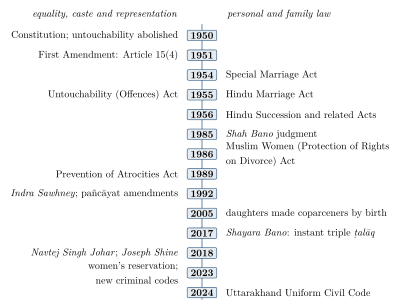
Yet the classical traditions discussed in this book did not simply disappear. Their vocabulary and symbols were used in the making of the Republic; the codification of Hindu personal law in the 1950s transformed but also preserved parts of the Dharmaśāstric inheritance; and the Arthaśāstra, Manu and the idea of dharma have continued to be invoked, admired and contested in Indian public life. This chapter examines that legacy. It tries to distinguish reception — the ways modern Indians have used and argued about the classical traditions — from derivation, the claim that the classical texts were the source of modern constitutional principles, which the records of the Constituent Assembly do not bear out. Figure 20.1 sets out the main legal milestones of the Republic discussed here.
20.1 The Constitution’s Break with Hierarchy
20.1.1 Equality and the Abolition of Untouchability
The Fundamental Rights in Part III of the Constitution guarantee equality before the law and the equal protection of the laws (Article 14), prohibit discrimination by the state on grounds only of religion, race, caste, sex or place of birth (Article 15) and guarantee equality of opportunity in public employment (Article 16). Article 17 declares: “ ‘Untouchability’ is abolished and its practice in any form is forbidden.” Article 25, which guarantees freedom of religion, expressly permits the state to provide for social reform and for “the throwing open of Hindu religious institutions of a public character to all classes and sections of Hindus” (Article 25(2)(b)). These provisions were drafted with the legal disabilities of the Dharmaśāstras and of caste custom in view; in substance they negate the varṇa-graded law described in Chapters 10 and 14. Parliament gave effect to Article 17 by the Untouchability (Offences) Act of 1955, later renamed the Protection of Civil Rights Act (1976), and by the Scheduled Castes and the Scheduled Tribes (Prevention of Atrocities) Act of 1989.
The Constitution also provided for affirmative measures: reserved seats in legislatures for Scheduled Castes and Scheduled Tribes, reservation in public employment and education, and a directive to promote the educational and economic interests of the weaker sections (Article 46). Marc Galanter’s study of these policies remains the classic account (Galanter 1984).
20.1.2 Before the Constitution: Temple Entry and Civil Rights
The constitutional abolition of untouchability crowned decades of struggle. Movements for the right of Dalits and other excluded castes to use public roads, tanks, schools and temples were a major feature of social reform in the 1920s and 1930s: the Vaikom satyagraha of 1924–25 in Travancore, which sought the right to use the roads around a temple and was supported by Gandhi and by E. V. Ramasamy; Ambedkar’s Mahad satyagraha of 1927 (Chapter 10); the Kalaram temple entry movement at Nashik from 1930; and the Guruvayur satyagraha of 1931–32. The Travancore Temple Entry Proclamation of 1936 opened the state’s temples to all Hindus, and several provinces passed temple-entry laws in the following years. These campaigns showed both the depth of resistance to equality and the possibility of change through organised action and law (Zelliot 1992).
20.1.3 Representation: The Poona Pact
The question of political representation for the “Depressed Classes” — the contemporary term for the castes regarded as untouchable — was fought out before independence. At the Round Table Conferences in London (1930–32), Ambedkar demanded separate electorates for them, as had been granted to Muslims and others; the British government’s Communal Award of 1932 conceded them. Gandhi, who regarded separate electorates for the Depressed Classes as a division of Hindu society, began a fast unto death in protest. Under intense pressure, Ambedkar agreed to the Poona Pact of September 1932, which replaced separate electorates with seats reserved for the Depressed Classes within joint electorates, in larger numbers than the Award had provided. Ambedkar later regarded the Pact as a defeat. The reserved constituencies of the Constitution descend from this settlement, and the episode remains central to debates about the relationship between Gandhi, Ambedkar and the politics of caste (Zelliot 1992).
20.1.4 Reservation and Its Debates
The policies of reservation have been among the most contested features of Indian constitutional law. After the Supreme Court struck down a caste-based reservation in education in State of Madras v. Champakam Dorairajan (1951), Parliament amended the Constitution in the same year to permit special provisions for socially and educationally backward classes and for the Scheduled Castes and Tribes (Article 15(4)). The extension of reservation in central government employment to the “Other Backward Classes” on the recommendation of the Mandal Commission (1980), implemented in 1990, provoked fierce protests; in Indra Sawhney v. Union of India (1992) the Supreme Court upheld it, while ruling that reservations should not normally exceed fifty per cent and that the “creamy layer” of the backward classes should be excluded. These debates are a modern chapter in the history of caste and law. They show the Constitution using caste categories in order to undo the disadvantages that a caste-based legal and social order had created (Galanter 1984).
20.1.5 Ambedkar’s Warnings
B. R. Ambedkar, chairman of the Drafting Committee, was clear that legal equality would not by itself abolish the social order that the śāstras had sanctioned. Moving the Draft Constitution on 4 November 1948, he quoted the historian George Grote on “constitutional morality” and added: “Constitutional morality is not a natural sentiment. It has to be cultivated. We must realize that our people have yet to learn it. Democracy in India is only a top-dressing on an Indian soil, which is essentially undemocratic.” In his final speech to the Assembly on 25 November 1949, he warned that on 26 January 1950 India would “enter into a life of contradictions”: in politics there would be equality, in social and economic life inequality (Constituent Assembly of India 1948, 1949). His insistence that political democracy must be accompanied by social democracy — “a way of life which recognizes liberty, equality and fraternity as the principles of life” — drew on his earlier critique of caste and the śāstras (Chapter 10) and on his reading of the Buddha’s dhamma (Chapter 8).
20.2 Dalit Legal and Political Thought after Ambedkar
Ambedkar’s critique of the śāstras and his work on the Constitution did not end with his death in 1956. They became the starting point of a body of Dalit political thought, organisation and scholarship that has shaped both the law of caste in the Republic and the way in which the classical texts discussed in this book are read.
20.2.1 Movements
The Republican Party of India, founded in 1957 along lines that Ambedkar had planned, carried his politics into electoral competition, though it soon divided. In 1972 young writers in Bombay, among them Namdeo Dhasal, Raja Dhale and J. V. Pawar, founded the Dalit Panthers, taking their name from the Black Panthers of the United States; they joined political militancy to a new Marathi literature of protest and did much to make “Dalit” — “broken”, “ground down” — the name by which the community described itself, in place of the official “Scheduled Castes” and Gandhi’s “Harijan”. In northern India Kanshi Ram organised Dalit and other government employees in BAMCEF (1978) and founded the Bahujan Samaj Party (1984), which sought to unite the “majority” (bahujan) of Dalits, Ādivāsīs, backward castes and religious minorities against upper-caste dominance; its leader Mayawati became Chief Minister of Uttar Pradesh four times from 1995 (Omvedt 1994; Zelliot 1992).
20.2.2 The Law of Caste in the Republic
These movements pressed the state to give effect to Article 17. The Untouchability (Offences) Act of 1955, renamed and strengthened as the Protection of Civil Rights Act in 1976, proved weak against the violence that met Dalit assertion, and Parliament enacted the Scheduled Castes and the Scheduled Tribes (Prevention of Atrocities) Act in 1989, which defined a range of “atrocities”, provided for special courts and restricted anticipatory bail. The Act was widened in 2015. In Subhash Kashinath Mahajan v. State of Maharashtra (2018) the Supreme Court introduced safeguards against arrest under it; after nationwide Dalit protests Parliament restored the earlier position by inserting section 18A, which the Court upheld in Prithvi Raj Chauhan v. Union of India (2020). A further question concerns religion. The Constitution (Scheduled Castes) Order of 1950 confined Scheduled Caste status to Hindus; it was extended to Sikhs in 1956 and to Buddhists in 1990, but Dalits who are Christians or Muslims remain outside it, an exclusion that Dalit organisations have long contested. The question shows how a category created to undo the effects of a Brahmanical social order is still defined by religion.
20.2.3 Scholarship
Dalit and Dalit-Bahujan scholars have also changed the terms in which caste is studied. The political theorist Gopal Guru has made humiliation a central category of social and political theory, and, with the philosopher Sundar Sarukkai, has asked who in Indian social science is allowed to theorise and whose experience is treated only as data (Guru 2009; Guru and Sarukkai 2012). Guru’s argument that “Dalit women talk differently” — that their experience of caste and patriarchy is represented neither by upper-caste feminism nor by male-led Dalit politics — opened a Dalit feminist literature, which Sharmila Rege developed through women’s life narratives (Guru 1995; Rege 2006). Kancha Ilaiah’s Why I Am Not a Hindu (1996) set the culture and knowledge of the labouring Dalit-Bahujan castes against what he called Brahmanical Hinduism (Ilaiah 1996). Anand Teltumbde has argued that the constitutional categories of reservation and protection have left caste violence and economic subordination largely intact (Teltumbde 2018), and Sukhadeo Thorat and Katherine Newman have documented discrimination in modern labour, credit and housing markets (Thorat and Newman 2010). Historians have traced the longer story: Gail Omvedt the Dalit movement under colonial rule, and Anupama Rao the way in which Dalits in western India became political subjects through the law’s categories of rights, representation and violence (Omvedt 1994; Rao 2009).
For the history of polity and law, this scholarship matters in two ways. It insists that the śāstras be read from the standpoint of those whom they excluded, which is one reason why this book sets out their provisions on varṇa and untouchability with their references rather than in paraphrase (Chapters 10 and 14). And it shows that the break with hierarchy described at the beginning of this chapter was not completed in 1950: it remains, as Ambedkar warned, a task of social as well as legal change.
20.3 The Directive Principles
Part IV of the Constitution, the Directive Principles of State Policy, sets out goals that are not enforceable in the courts but are declared to be “fundamental in the governance of the country”. They were modelled in part on the Irish Constitution of 1937, and they reflect the socialist, Gandhian and liberal currents of the national movement. They direct the state to secure a social order based on justice, social, economic and political (Article 38); adequate means of livelihood for all, the prevention of the concentration of wealth, equal pay for equal work and the protection of children (Article 39); the organisation of village pañcāyats (Article 40); the right to work, to education and to public assistance in old age, sickness and disablement (Article 41); a living wage (Article 43); the promotion of the educational and economic interests of the weaker sections, especially the Scheduled Castes and Scheduled Tribes (Article 46); the prohibition of intoxicating drinks (Article 47); the organisation of agriculture and animal husbandry on modern lines and the prohibition of the slaughter of cows and calves (Article 48); and a uniform civil code (Article 44).
Popular writing sometimes presents these principles as a modern form of rājadharma, matching each Article with a verse of the Arthaśāstra or Manu. Such parallels are not supported by the records of the Constituent Assembly, whose debates on the Directive Principles drew on modern constitutional models and on the programmes of the national movement. Some provisions — the pañcāyats, prohibition and the protection of cattle — do reflect Gandhian and Hindu sentiment in the Assembly; the protection of the weaker sections reflects Ambedkar’s concerns. The ideal that a ruler should seek the welfare of his people is ancient and widespread; the specific programme of Part IV is a twentieth-century one (Austin 1966). Nor did the new rights remain the property of lawyers and legislators. Rohit De has shown how, in the Republic’s first decade, ordinary citizens — butchers, traders, sex workers and others — went to court under the fundamental rights to challenge measures such as prohibition and bans on cow slaughter, some of them adopted in the name of the Directive Principles, so that the Constitution became a part of everyday life (De 2018).
20.4 Symbols of the Republic
The Republic adopted classical symbols. Its national emblem, adopted on 26 January 1950, is an adaptation of the lion capital of the Aśokan pillar at Sarnath, with the motto satyam eva jayate, “truth alone conquers”, from the Muṇḍaka Upaniṣad (3.1.6). The wheel at the centre of the national flag, adopted in July 1947, is the wheel of dharma from the same capital. The original manuscript of the Constitution was calligraphed by hand and illuminated by artists working under Nandalal Bose of Santiniketan, with scenes from Indian history and mythology — from the Indus civilisation and the Vedic hermitage to the Buddha, Aśoka, Vikramāditya’s court, Akbar, Śivājī, Guru Gobind Singh and Gandhi.
The name of the country was also debated. Article 1 of the Constitution begins: “India, that is Bharat, shall be a Union of States.” Members of the Constituent Assembly proposed various names — Bharat, Bharatavarsha, Hind, Hindustan — and the compromise formula recognised both the English name and the Sanskrit name with its Purāṇic associations.
The choice of Aśokan symbols was deliberate. Jawaharlal Nehru and others saw in Aśoka a model of a ruler who had combined power with ethical restraint and religious tolerance, and the symbols linked the new state to an Indian past that was neither specifically Hindu nor Brahmanical. These are acts of reception by a modern state; they tell us how the founders wished the Republic to be understood, not that the Constitution derived its principles from Aśoka.
20.5 Codifying Hindu Law
20.5.1 The Hindu Code Bill
The most direct encounter between the Constitution’s principles and the Dharmaśāstric inheritance was the codification of Hindu personal law. A Hindu Law Committee chaired by B. N. Rau prepared a draft code in the 1940s. As Law Minister after independence, Ambedkar took up the project: his Hindu Code Bill proposed to replace the textual law of the Mitākṣarā and Dāyabhāga, as interpreted by the courts, with a single code providing for monogamy, divorce, the abolition of caste restrictions on marriage and adoption, and equal inheritance for daughters. It met fierce opposition, inside and outside Parliament, from those who saw it as an attack on Hindu tradition. In 1951 the government withdrew it, and Ambedkar resigned from the cabinet, citing the failure to enact it among his reasons (Som 1994; Newbigin 2013).
20.5.2 The Acts of 1955–56
After the first general election, the government enacted the substance of the Bill in four statutes. The Hindu Marriage Act (1955) made monogamy compulsory, allowed divorce on specified grounds, and recognised marriages between persons of different castes; it retained the ceremonies of customary Hindu marriage, providing that where the seven steps (saptapadī) are part of the rite, the marriage is complete when the seventh is taken (Chapter 15). The Hindu Succession Act (1956) gave daughters, widows and mothers equal shares with sons in a man’s separate property and made women absolute owners of their property, but it preserved the Mitākṣarā coparcenary in which only males had birthrights. The Hindu Minority and Guardianship Act (1956) and the Hindu Adoptions and Maintenance Act (1956) completed the scheme.
Reba Som and Eleanor Newbigin have shown that the result was a compromise: the codes extended a single law to all who counted as “Hindus” — including Buddhists, Jains and Sikhs — and introduced major reforms, but they also retained the joint family and the coparcenary and thus the economic advantages of sons (Som 1994; Newbigin 2013). Flavia Agnes has argued that the reforms did less for women than their reputation suggests and that many of their benefits were limited to the middle classes (Agnes 1999). The Hindu Succession (Amendment) Act of 2005 made daughters coparceners by birth with the same rights as sons, and in Vineeta Sharma v. Rakesh Sharma (2020) the Supreme Court held that this right does not depend on the father having been alive when the amendment came into force (Chapter 11).
20.5.3 Continuity and Change
The Hindu codes thus both broke with and continued the Dharmaśāstric tradition. They abolished its varṇa distinctions, its polygyny, its denial of divorce and its exclusion of daughters from inheritance; they retained its sacramental understanding of marriage, its joint family and, until 2005, its male coparcenary; and they continued to treat religion as the basis of family law. Judges and lawyers still cite Dharmaśāstra texts and their colonial interpretations in some areas — for example, in cases about Hindu religious endowments, the status of deities as legal persons, and customary marriage ceremonies — but the governing law is statutory.
20.6 Personal Law and the Uniform Civil Code
20.6.1 A Plural System
India’s personal law system is a legacy of the colonial division of family law by religion (Chapter 19). Hindus (including Buddhists, Jains and Sikhs), Muslims, Christians and Parsis are governed in marriage, divorce, maintenance, adoption and succession by separate bodies of law, some codified and some uncodified, while the Special Marriage Act of 1954 provides a civil alternative open to all. Goa has its own civil code, inherited from Portuguese rule. Scheduled Tribes are often governed by custom (Chapter 16).
20.6.2 Muslim Personal Law after 1947
Independent India retained the Muslim Personal Law (Shariat) Application Act of 1937 and the Dissolution of Muslim Marriages Act of 1939 (Chapter 19). Muslim marriage, divorce, maintenance and inheritance therefore continued to be governed by a largely uncodified body of Ḥanafī law — and, for Shīʿī Muslims, of Twelver law — as interpreted by the courts and supplemented by statute. Religious and charitable endowments were placed under state boards by the Wakf Act of 1954, which was replaced by the Waqf Act of 1995 and substantially amended in 2025. The All India Muslim Personal Law Board, founded in 1973, became the most prominent voice of those who held that the personal law was a matter for the community and its scholars rather than for Parliament, and the controversies over maintenance and triple ṭalāq described below were in part disputes over that claim. Muslim women’s organisations and reformers have meanwhile sought change both from within the tradition and through the courts. The history illustrates a general feature of Indian personal law: the state and the religious communities have both claimed authority over bodies of law that were themselves shaped to a large extent by the colonial courts.
20.6.3 Civil Marriage and Choice
Alongside the religious personal laws, the Special Marriage Act of 1954 allows any two persons, irrespective of religion, to marry by civil registration, and marriages under it are governed by secular rules of divorce and succession. The Act extended a colonial statute of 1872 that had been available only to those who declared that they professed no religion. It has been the main legal route for interfaith marriages, though its requirement of public notice before the marriage has been criticised for exposing couples to harassment. The courts have repeatedly affirmed the right of adults to marry a person of their choice, against the opposition of families and communities (Chapter 16). The contrast with the Dharmaśāstras, in which marriage was arranged by fathers within the bounds of varṇa and gotra, is complete.
20.6.4 Article 44
Article 44, among the non-justiciable Directive Principles, provides that “the State shall endeavour to secure for the citizens a uniform civil code throughout the territory of India.” Where to place the clause was settled early. In 1947 the Assembly’s sub-committee on fundamental rights decided by a majority that a uniform civil code should not be a justiciable right; Minoo Masani, Hansa Mehta and Rajkumari Amrit Kaur dissented, arguing that personal laws based on religion stood in the way of national unity and of equality for women (Austin 1966).
When the draft article (then numbered 35) came before the Constituent Assembly on 23 November 1948, Mohamed Ismail Sahib, Naziruddin Ahmad, Mahboob Ali Baig and B. Pocker Sahib moved amendments to protect the personal law of any group or community from change without its consent. They argued that personal law was part of religious observance, that the freedom of religion guaranteed elsewhere in the draft would otherwise be weakened, and that a code imposed by the majority would breed discontent among the minorities. K. M. Munshi replied that the Shariat Act of 1937 had itself overridden the customs of the Khojas and Cutchi Memons, that countries with Muslim majorities such as Turkey and Egypt did not exempt their minorities from a common civil law, and that the clause would equally require the reform of Hindu law, which many Hindus resisted. Alladi Krishnaswami Ayyar pointed to the uniform criminal and commercial law that India already had. Ambedkar, closing the debate, observed that India already had a uniform law in almost every field except marriage and succession, that until the 1930s Muslims in the North-West Frontier Province and elsewhere had followed customary rules of succession close to Hindu law, and that the article only required the state to “endeavour”. A future Parliament, he suggested, might make a code applicable at first only to those who declared their willingness to be bound by it. The amendments were rejected and the article adopted (Constituent Assembly of India 1948).
The debate set the terms of the later controversy. Both sides treated the Hindu Code then being prepared as part of the same question, so that the reform of Hindu law in 1955–56 (Section 20.5) was in one sense a partial, community-by-community step towards the goal of Article 44, and in another a reason why Muslims came to see the demand for a uniform code as directed at them. Ambedkar’s idea of a voluntary code was realised in part by the Special Marriage Act of 1954, described above.
20.6.5 Courts and Controversies
The tension between personal law and constitutional equality has produced some of the most contested judgments in Indian legal history. In Mohd. Ahmed Khan v. Shah Bano Begum (1985), the Supreme Court held that a divorced Muslim woman could claim maintenance from her former husband under the general provision of the Code of Criminal Procedure, and remarked on the desirability of a uniform civil code; the political reaction led Parliament to pass the Muslim Women (Protection of Rights on Divorce) Act of 1986, which was widely seen as reversing the decision. In Danial Latifi v. Union of India (2001), the Court upheld the 1986 Act but interpreted it to require a reasonable and fair provision for the divorced wife’s future. In Sarla Mudgal v. Union of India (1995), it held that a Hindu husband could not escape the prohibition of bigamy by converting to Islam. In Shayara Bano v. Union of India (2017), a majority of the Court held the practice of instant “triple ṭalāq” unconstitutional or invalid, and Parliament subsequently made it an offence. Cases concerning women’s entry into temples, such as the Sabarimala case of 2018, raised similar questions about the relation between religious practice and equality within the Hindu fold.
20.6.6 The Debate
Supporters of a uniform civil code argue that equality before the law and gender justice require a single family law for all citizens, and that personal laws in all communities discriminate against women. Opponents argue that a uniform code imposed by a majority would threaten minority identities and that reform should come from within communities. Feminist scholars such as Flavia Agnes have criticised both the majoritarian appropriation of the uniform code demand and the conservatism of community leaderships, and proposed reforms that would secure women’s rights across personal laws (Agnes 1999). The political theorist Ayelet Shachar has proposed “transformative accommodation”, in which communities retain authority over some matters while individuals can invoke state law to protect their rights (Shachar 2001). Narendra Subramanian’s comparative history of the personal laws since independence shows that each of them — Hindu, Muslim, Christian and Parsi — has been reshaped through negotiation between the state, community leaders and reformers within the community, so that the choice has never been simply between an unchanged religious law and a uniform code (Subramanian 2014).
Official bodies have reached different conclusions. The Law Commission of India, asked by the government in 2016 to examine the question, issued a consultation paper in 2018 which concluded that a uniform civil code was “neither necessary nor desirable at this stage” and recommended instead that discriminatory provisions be removed from each personal law, with reforms such as equal rights of inheritance and a common minimum age of marriage; its successor commission invited the public’s views afresh in 2023. Goa’s civil code, derived from the Portuguese Civil Code of 1867 and retained after 1961, is often cited as a working model, though it too contains provisions specific to particular communities. In 2024 the state of Uttarakhand enacted a uniform civil code for its residents, excluding Scheduled Tribes; in force from January 2025, it prescribes common rules of marriage, divorce and succession and requires the registration of marriages and of couples living together outside marriage. Its supporters present it as the fulfilment of Article 44; its critics object to its registration requirements and question whether a state law can achieve uniformity. The national debate continues.
Proponents of both positions sometimes appeal to the classical tradition — to the Dharmaśāstras’ recognition of regional and community custom as a model of pluralism, or to the ideal of a single dharma for all. Neither appeal is straightforward. The pluralism of the śāstras was a hierarchical pluralism, in which different groups had different rights because they had different status; the “single dharma” was the dharma of the varṇa order. The modern debate is about how a democratic state committed to equal citizenship should accommodate religious and cultural diversity, a question the classical texts did not ask.
20.7 Religion, Endowments and the State
A further area in which the Constitution engaged with the classical inheritance is the relationship between the state and religious institutions. Article 25 guarantees freedom of conscience and the right freely to profess, practise and propagate religion, subject to public order, morality and health, and permits the state to regulate the secular activities associated with religious practice and to provide for social reform. Article 26 guarantees religious denominations the right to manage their own affairs in matters of religion and to own and administer property in accordance with law. In the Shirur Mutt case (Commissioner, Hindu Religious Endowments, Madras v. Sri Lakshmindra Thirtha Swamiar, 1954), the Supreme Court held that what constitutes an essential part of a religion is to be ascertained from the doctrines of that religion itself, and that the state may regulate the secular administration of religious institutions but not their essential religious practices. The “essential practices” test that developed from this case has required courts to decide questions about Hindu and other religious traditions — for instance, whether a particular rule of temple worship or entry is essential to the religion — and has drawn them into the interpretation of texts and customs.
Several states continue to administer large Hindu temples through statutory boards, a practice inherited from the colonial period, while the endowments of other religions are governed by their own statutes, such as the Waqf Act. The arrangement illustrates the peculiar position of Indian secularism, which neither separates state and religion completely nor establishes a state religion, but regulates and reforms religious institutions in the name of equality and public order (Galanter 1989).
20.8 The Courts and the Classical Texts
Indian courts have on occasion referred to the classical texts, and some judges have written about dharma in speeches and essays. Such references are usually illustrative: a judge may quote Manu or the Mahābhārata on the duty of the king to protect his subjects, or on truth in testimony, to adorn a judgment that rests on constitutional and statutory grounds. They do not show that constitutional doctrines such as the “basic structure” of the Constitution (Kesavananda Bharati v. State of Kerala, 1973) or the expansive interpretation of the right to life and personal liberty (Maneka Gandhi v. Union of India, 1978) were derived from Dharmaśāstra; those doctrines rest on constitutional reasoning and on comparative constitutional law. Claims that particular judges based landmark decisions on concepts such as rājadharma or the ātman should be treated with caution unless the passages can be identified in the judgments.
Courts have also confronted classical norms directly. The Supreme Court’s decision on adultery (Section 20.11) rejected a conception of the wife as her husband’s property that the colonial code had shared with the Dharmaśāstras, and its judgments on khap pañcāyats (Chapter 16) and on untouchability have set constitutional limits on the authority of caste and custom.
20.9 Kauṭilya in Modern India
The Arthaśāstra has had a remarkable modern career. After its rediscovery (Chapter 3), nationalist historians cited it as proof that ancient India had possessed a sophisticated science of government, and Max Weber’s remark comparing it with Machiavelli made it known in European political thought. In independent India, Cāṇakya became a national symbol of political wisdom: the diplomatic enclave in New Delhi is named Chanakyapuri, and his name is attached to institutes, awards and conferences. In recent decades, the Arthaśāstra has been studied in courses on strategic thought and international relations, and Roger Boesche and others have presented Kauṭilya as an early political realist (Boesche 2002). Popular management literature presents “Kautilyan” principles of leadership.
These uses are part of the text’s reception history and are legitimate subjects of study. They often, however, rest on the traditional dating of the text to the Mauryan period and on a selective reading that emphasises its realism and its welfare provisions while passing over its espionage, coercion and hierarchy. The scholarly understanding of the Arthaśāstra as a composite text of c. 50 BCE–300 CE, revised to accommodate dharmaśāstric norms (Chapter 3), and the attention of historians such as Upinder Singh to its violence (Singh 2017), provide a necessary corrective. It is one thing to find the text illuminating, another to read modern realism, the welfare state or the mixed economy into it.
20.10 Dharma, Rāmarājya and Modern Politics
The language of dharma and kingship has also been used in modern political argument. M. K. Gandhi described his ideal of a just and non-violent polity as Rāmarājya, explaining that he meant not Hindu rule but a rule of righteousness, open to people of all faiths. Ambedkar, by contrast, criticised the figure of Rāma for his treatment of Sītā and of Śambūka (Chapter 5), and many Dalit and rationalist writers have rejected the ideal of Rāmarājya as a nostalgia for caste society. Hindu nationalist movements have invoked dharma and Rāma in a different spirit, as symbols of national and religious identity. The Constitution’s own language is secular: the word dharma does not appear in its operative provisions, and the word “secular” was added to the Preamble in 1976. The forty-second amendment of the same year also added a list of “fundamental duties” of citizens (Article 51A), which some writers have compared with the classical language of duty, although these duties fall on every citizen alike and not by varṇa or sex.
These uses of the past are part of contemporary politics, and this book does not take sides in them. Its concern has been to establish, as accurately as possible, what the classical texts said and how they were used historically, so that modern arguments about them can at least proceed from a sound understanding of their content.
20.11 Criminal Law after Independence
Independent India retained the colonial criminal law — the Indian Penal Code of 1860, the Code of Criminal Procedure and the Indian Evidence Act of 1872 — and amended it piecemeal. Several of the most important changes concerned matters that the Dharmaśāstras had also regulated, and they show how far the modern law has moved from the classical assumptions about gender, caste and sexuality discussed in earlier chapters.
The law of sexual violence was transformed in stages. Public protest after the Supreme Court’s acquittal of two policemen accused of raping a young tribal woman in the Mathura case (1979) led to amendments in 1983 that, among other things, shifted the burden of proof in custodial rape. In Vishaka v. State of Rajasthan (1997) the Court laid down guidelines against sexual harassment at the workplace, later replaced by a statute of 2013. After the gang rape and murder of a young woman in Delhi in December 2012, the Criminal Law (Amendment) Act of 2013 widened the definition of rape and introduced new offences. The Protection of Women from Domestic Violence Act of 2005 provided civil remedies against violence within the home. These measures rest on the premise, foreign to the Dharmaśāstras, that a woman’s bodily autonomy is a right that the law must protect against her husband and family as well as against strangers.
The courts also struck down provisions that had embodied older moral assumptions. In Joseph Shine v. Union of India (2018) the Supreme Court held the offence of adultery, which had punished only the man who had relations with another man’s wife and treated the wife as her husband’s property, to be unconstitutional (Chapter 14). In Navtej Singh Johar v. Union of India (2018) it held that section 377 of the Penal Code, a colonial provision criminalising “carnal intercourse against the order of nature”, could not be applied to consensual sexual relations between adults; in National Legal Services Authority v. Union of India (2014) it recognised the right of transgender persons to self-identification. Laws against caste atrocities (Section 20.1) belong to the same development.
In 2023 Parliament replaced the three colonial codes with the Bharatiya Nyaya Sanhita, the Bharatiya Nagarik Suraksha Sanhita and the Bharatiya Sakshya Adhiniyam, which came into force on 1 July 2024. The new codes retain much of the structure and substance of the old, while reorganising and renaming offences; their supporters presented them as a decolonisation of the criminal law, and their critics questioned how far they departed from the colonial model. The names, drawn from Sanskrit, illustrate once more the use of the classical vocabulary of nyāya and rakṣā to frame modern legislation — a vocabulary whose classical contents, as this book has shown, were very different.
20.12 Women in the Republic
The Dharmaśāstras’ maxim that a woman is not fit for independence (Manu 9.3) stood in sharp contrast to the political order created in 1950. The Constitution granted the vote to every adult citizen, women and men alike, without the property and educational qualifications that had limited the franchise — including the limited franchise extended to some women in the provinces from the 1920s — under colonial rule. Fifteen women sat in the Constituent Assembly. Among them, Hansa Mehta also served on the United Nations Commission on Human Rights, where she is credited with securing the wording “all human beings” in place of “all men” in the first article of the Universal Declaration of Human Rights; Dakshayani Velayudhan, the only Dalit woman in the Assembly, spoke for the abolition of untouchability and for a constitution grounded in the people’s own needs.
Formal equality was followed, slowly, by measures to increase women’s representation. The amendments of 1992 reserved one-third of the seats in rural and urban local bodies for women (Chapter 16). The Constitution (One Hundred and Sixth Amendment) Act of 2023 provides for the reservation of one-third of the seats in the Lok Sabha and the state legislative assemblies for women, to take effect after the delimitation of constituencies following the next census. The persistence of low female representation in legislatures for more than seventy years after 1950, and the long campaign required for this amendment, show how far political equality for women depended on deliberate legal change rather than on any inheritance from the classical ideals of rājadharma, in which political authority was in principle male (Agnes 1999).
20.13 Conclusion
The classical Indian traditions of polity and law were among the most elaborate intellectual achievements of the pre-modern world. The Arthaśāstra analysed the resources of the state and the relations between states with a precision few ancient texts can match; the Dharmaśāstras developed a law of procedure, evidence, contract and inheritance of real technical sophistication; Buddhist and Jain thinkers offered alternative accounts of kingship and of the duties of rulers; Islamic jurists and Mughal administrators built a second great legal tradition on Indian soil; and custom, community and local institutions governed the lives of most people. These traditions were also, in central respects, systems of hierarchy and coercion, in which rights and penalties depended on birth and sex and the power of the king and of dominant groups was legitimated by religion.
Modern India’s Constitution chose a different foundation: the equal citizen with enforceable rights. It retained classical symbols, codified parts of the classical law and left room for custom and community, but it subordinated all of them to the principle of equality. The task of reading the classical traditions today is therefore not to find in them the source of modern values, but to understand them as they were — their achievements and their exclusions together — and to judge, in the light of the values the Constitution affirms, what in them deserves to be remembered and what deserves to be left behind.
20.14 Summary
-
The Constitution of 1950 made the individual citizen with enforceable rights the basis of the polity, guaranteed equality before the law regardless of caste and sex, and abolished untouchability — negating the varṇa-graded law of the śāstras.
-
Ambedkar warned that political equality would coexist with social inequality; the Dalit movements and scholarship that followed him have shaped the law of caste and the reading of the śāstras.
-
The Republic’s classical symbols are acts of reception, not evidence that its principles derived from the classical texts.
-
The Hindu Code of 1955–56 transformed the Mitākṣarā and Dāyabhāga law while preserving parts of it; personal law remains divided by religion, and the uniform civil code is still debated.
Further Reading
On the making of the Constitution, see Austin (1966), and on its first decade in the courts De (2018); on affirmative action and caste, Galanter (1984); on law and society, Galanter (1989). Dalit political thought after Ambedkar can be approached through Omvedt (1994), Guru (2009), Rao (2009) and Teltumbde (2018). The Hindu Code is studied by Som (1994) and Newbigin (2013); women’s rights and personal law by Agnes (1999) and Subramanian (2014); theories of accommodation by Shachar (2001). Menski (2003) surveys modern Hindu law; Lubin et al. (2010) includes chapters on law and religion in modern India.